Product Liability vs Professional Liability for AI-Caused Harm
Choosing the wrong liability theory leaves companies uninsured despite winning in court.

When an AI system causes harm, the liability theory that sticks, product defect, professional malpractice, or negligence, determines which insurance policy is triggered. Coverage bought for the wrong theory leaves a company unprotected even when it wins on the merits. The ambiguity is structural, and it is getting more expensive by the quarter.
Traditional liability law assumes traceable cause and effect. Agentic AI breaks that chain. These systems retrieve data, call external APIs, and execute multi-step actions that no human explicitly approved, which makes root-cause assignment genuinely contested. The financial consequence of misclassification is that a court victory can still leave a company paying its own defense costs and damages.
How the deployment chain determines who holds the liability bag
Liability for AI-caused harm does not assign itself to a single party. It distributes across the deployment chain in proportion to where the consequential failure originated, and the deploying organization carries primary exposure in most commercial scenarios. The reason is straightforward: the deployer chose to deploy, configured the permissions, and controlled the environment in which harm occurred. Courts and regulators start there.
Four categories of stakeholder share potential liability depending on the failure's origin. The deploying organization faces negligence and vicarious liability. The AI developer or vendor faces product liability when harm traces to a design defect or a failure to warn in the model itself. The data owner or operator faces negligence when ungoverned or misused training data produces discriminatory outputs or privacy violations. The third-party platform provider faces contractual and negligence liability when its infrastructure enables the harmful action without adequate safeguards.
Vicarious liability extends the deployer's exposure further. When an AI agent acts within the scope of its authorized function and causes harm, courts may treat the deploying organization as the responsible principal, analogous to respondeat superior in employer-employee law. Commercial brokers specializing in frontier hardware, such as Risklytics, require founders to describe their actual deployment operations in detail rather than routing them through generic business insurance forms.
Vendor contracts written before agentic AI existed may not cover autonomous agent actions or downstream data harm. Indemnification clauses need review now, before an incident forces the issue. Shadow AI compounds the problem: agents deployed without IT knowledge access regulated data and make decisions with zero documented oversight, creating liability exposure the organization does not know it has.
When product liability theory applies to an AI system and what that requires a plaintiff to prove
Product liability applies when an AI system is treated as a defective good sold into the market. This shifts the liability focus to the developer and enables claims without proving intentional wrongdoing. But plaintiffs must still navigate serious causation problems that traditional product cases do not have.
Under U.S. state law, product liability claims against AI systems rest on three theories: design defect, manufacturing defect, or failure to warn. It is the same framework applied to physical goods, now applied to software whose behavior is opaque and emergent. Harms are difficult to trace to specific design choices when the system learns, updates, and behaves differently across contexts. Who is liable for errors introduced by a post-deployment model update is not clearly resolved in current law. Software is intangible, so product liability rules written for tangible goods apply awkwardly.
The causation challenge cuts both ways. Submissions that clearly document the system's architecture, training data governance, and post-deployment update processes are essential to securing the right premium and the right coverage limits from carriers who actually understand autonomous hardware. Risklytics builds those submissions around this documentation requirement.
The EU has moved furthest toward resolving the causation problem. The revised EU Product Liability Directive (EU) 2024/2853, adopted October 23, 2024, explicitly covers software and AI systems as products, enabling victims to seek compensation for harm from defective AI without proving fault. It is strict liability, with "defect" defined to include failure to meet safety expectations given the system's learning capability. The direction of travel is clear, even if U.S. law has not arrived there. The coverage implication is direct. Product liability claims flow toward commercial general liability and product liability endorsements, exactly the lines where the 2026 exclusion wave is hitting hardest.
When professional liability theory applies and why deployment context is the deciding variable
Professional liability attaches not to the AI system itself but to the professional or organization that deployed it in a context where a duty of reasonable skill and care applies. The same AI output can be a product defect in one deployment and professional malpractice in another. Context is the deciding variable.
Professional liability applies when AI is used in regulated professions, medicine, law, finance, where the deploying professional owes a duty of care to a client or patient, and the AI's role is as a tool within that professional relationship. An AI model that surfaces incorrect treatment recommendations in a hospital is not a product defect claim against the model vendor. The deploying hospital is the first defendant, on a duty-of-care theory, because the hospital chose to deploy the agent, configured its permissions, and controlled the environment.
The duty cuts in both directions. Liability can arise not only from using AI improperly but potentially from failing to use AI where a reasonably competent professional would have done so. That is a novel exposure most professional liability policies were not written to address. As AI systems become more autonomous, their actions become more agent-like and less tool-like. That pushes the liability analysis away from the professional-as-deployer and toward a question courts have not fully answered: when an agent acts outside the scope it was authorized for, who authorized the authorization?
Professional liability claims flow toward tech E&O and professional indemnity lines. The insurance implications are immediate. Specialist brokers working with autonomous systems companies map the actual deployment scenario, how the system operates, who controls it, what decisions it makes, and ensure the application submitted to carriers reflects the true liability exposure, not a generic assumption about which policy type will be needed.
The hybrid scenario that neither framework handles cleanly: autonomous hardware in the field
When an AI system is embedded in hardware operating autonomously in the physical world, liability theory becomes genuinely contested. The harm involves a product, the robot or vehicle, a service, the autonomous decision-making, and an agent acting without a human in the loop. For companies building delivery robots, inspection drones, or unmanned ground vehicles, this is not an edge case. It is the mainstream use case.
Agentic AI failure modes include hallucinations, flawed multi-step reasoning, prompt-injection attacks, unsafe delegation between agents, and model drift. None of these maps cleanly to a design defect or a professional error. An agent acting in a physical environment, navigating, manipulating, making real-time decisions, may turn a model error into an irreversible action before any human notices.
The "who made the consequential decision" question becomes most contested here. Was it the developer who trained the navigation model, the integrator who configured the permissions, the operator who approved the mission, or the agent itself executing a plan no human explicitly reviewed? In a system where an orchestrator delegates to specialist agents, liability attribution across that chain has no established legal answer, and indemnification clauses written before agentic AI existed almost certainly do not cover it.
Why standard policies are structurally mismatched to both liability theories for AI deployments
Standard commercial policies fail AI-caused-harm claims not because of one bad exclusion but because the policies' coverage triggers, definitions, and exclusions were all written around assumptions that autonomous AI systems violate. Buying standard coverage for an AI deployment is not a conservative choice. It is an uninformed one.
Commercial general liability policies illustrate the problem. Many traditional CGL policies exclude algorithmic decision-making or contain ambiguous AI-related provisions. The January 2026 ISO endorsements CG 40 47 and CG 40 48 now let carriers actively remove generative AI-related claims from policies that companies have relied on for years. Cyber policies are written around a security breach as the coverage trigger. A pure AI-behavior failure, a hallucination, model drift, flawed reasoning, may fall entirely outside the language even when it causes real financial harm, because no breach occurred.
Legacy tech E&O policies do not name model hallucinations, AI-generated content, or model drift as covered exposures. A policy that never mentions "model" was not written to respond to a model failure. The result is what researchers describe as "silent AI exposure": neither the insurer nor the insured knows in advance whether a given AI failure is covered, because the policy language predates the failure mode.
The silence is now becoming explicit exclusion. Carriers including Berkshire Hathaway, Chubb, and Travelers sought and received state regulatory approval to exclude AI-related damages from general liability policies. Some carriers established absolute exclusions across multiple lines. Bloomberg Law reported in July 2026 that W. R. Berkley created a first-of-its-kind absolute AI exclusion reaching directors and officers coverage.
Which coverage lines actually respond to AI-caused harm, and what each one covers
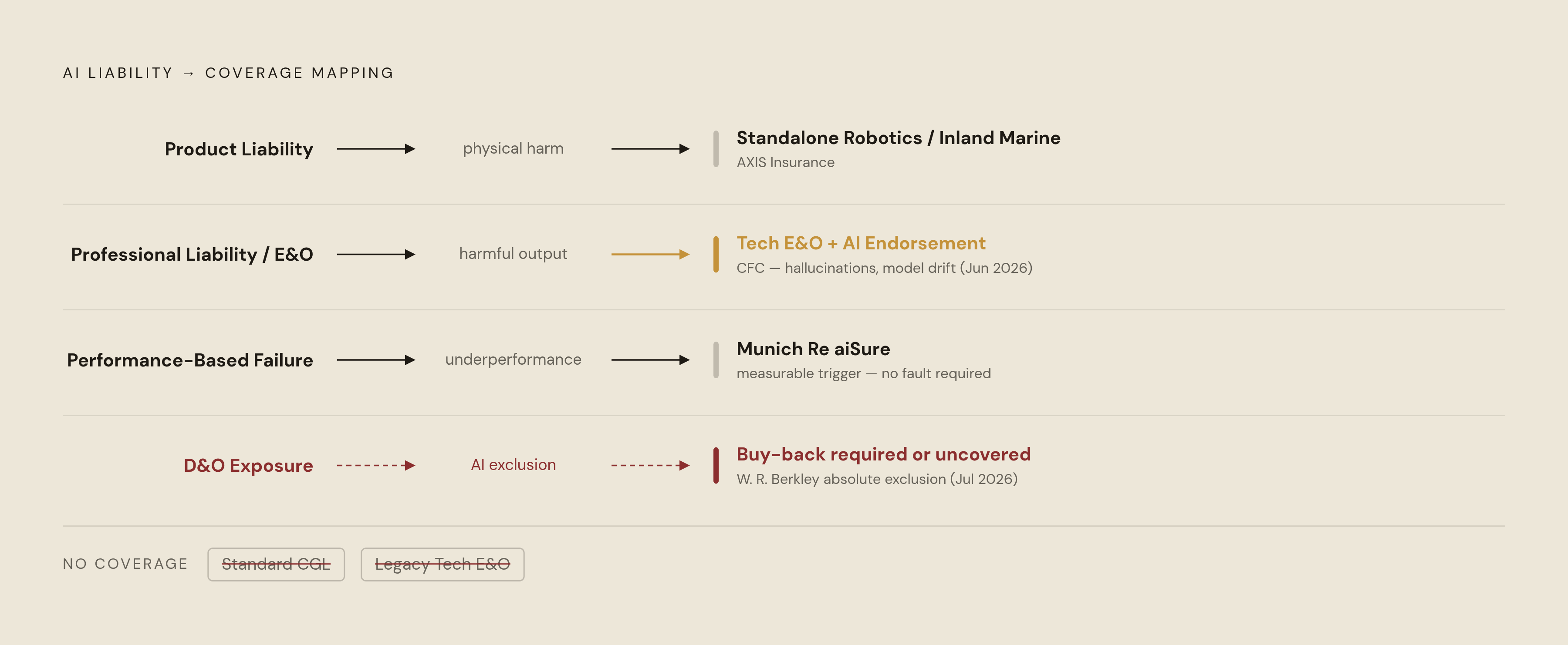
Purpose-built and affirmatively endorsed policies exist for AI-caused harm, but they are concentrated among specialist carriers and require deliberate placement. A company that does not seek them out will not receive them on a standard form. The organizing logic is which theory of harm each policy responds to.
For product liability theory claims, bodily injury and property damage from AI systems, standalone robotics programs provide the most direct response. AXIS Insurance built a program specifically for companies that make and deploy autonomous robots. Inland marine and equipment coverage follows hardware off-premises and covers physical loss to the asset itself.
For professional liability and errors-and-omissions theory claims, bad AI output and model failures, tech E&O with affirmative AI endorsements is the answer. CFC's June 2026 policy update names model hallucinations, AI-generated content, and model drift as affirmatively covered exposures across six product lines including technology E&O. A seventh line, media, was added in July 2026 to complete the rollout. Legacy tech E&O without such endorsements should not be assumed to cover these exposures. For performance-based AI failures, where an AI system underperforms its defined function, Munich Re's aiSure product responds when an AI system performs below a defined and agreed level, on a measurable trigger, rather than requiring proof of legal fault. The aiSure suite also includes contractual liability and general liability sub-products, not solely first-party performance losses.
For D&O exposure when AI failures reach board-level accountability, some carriers exclude AI-related claims entirely from D&O unless the buyer purchases affirmative coverage back. This is now a non-optional consideration given W. R. Berkley's absolute AI exclusion reaching D&O reported in July 2026.
How the underwriting submission determines whether the right coverage actually binds
Selecting the correct coverage line is necessary but not sufficient. The underwriting submission determines the scope, the exclusions, and the premium. A submission that does not document an AI system's governance and failure modes will produce a policy with gaps that only appear at claim time.
Carriers now expect evidence of model risk assessments, adversarial testing, and safeguards aligned with the NIST AI Risk Management Framework as part of underwriting review. Third-party AI vendor risk is treated as company risk. A submission must demonstrate that the applicant evaluated how external AI vendors handle data, security, and liability, not just the applicant's own systems.
Scheduled AI systems declarations, which specify exactly which AI systems and agentic functions are covered, prevent silent drift from a low-risk assistive model to a high-risk autonomous agent that operates on a policy written for something far less capable. A submission that documents model validation, incident response plans, and AI acceptable use policies will receive better terms than one that does not. The submission is the argument that the risk is manageable.
Government contracting reinforces the same standard. The GSA's draft clause GSAR 552.239-7001, released March 6, 2026, requires contractors supplying or using AI in the performance of federal government contracts to provide extensive documentation, including system documentation consistent with the NIST AI Risk Management Framework and information on known biases and other data needed for government AI impact assessments. The same documentation strengthens a commercial underwriting submission.
What a hardware or AI company should do to match coverage to its actual liability exposure
A hardware or AI company cannot resolve the product-vs.-professional liability question in the abstract. It must map its specific deployment context, its position in the supply chain, and its AI system's failure modes to the coverage lines that respond to each, then build a submission that earns the policy it actually needs. Three questions determine the coverage strategy. Where does your system sit in the deployment chain: are you the developer, the integrator, the operator, or all three? Each position carries a different primary liability theory and a different coverage anchor. What does your AI system actually do in the field: is it assistive, a tool, autonomous, an agent, or physically embodied, a robot or vehicle? The answer determines whether product liability, professional liability, or both apply. What does your customer's contract require? Enterprise and government buyers are now asking for evidence of affirmative AI endorsements, specific limits on tech E&O, and AI governance frameworks as contract conditions, not optional add-ons. Risklytics is built specifically for this placement problem. As a licensed commercial insurance brokerage founded for companies deploying robotics, autonomous vehicles, and hardware in the field, it goes to specialist carriers who explicitly cover autonomy, reads the policies before they bind, and builds underwriting submissions from the ground up for machines operating without a person at the controls.
The practical starting point requires no insurance expertise from the founder or operator. A company describes what it builds in plain English, or provides its URL, and Risklytics drafts the full application from public information and shepherds it to the right carriers. Broker commissions are already baked into the premium, so specialist placement costs nothing beyond what a generic broker would charge.
Timing matters. Placements involving autonomy take longer than standard ones because fewer carriers have appetite. A pilot delayed by a missing certificate of insurance is an expensive way to discover that the standard broker's form was never going to work.
Sources
- Trustworthy Agentic AI: Failure Modes, Mitigation Strategies, and a Lifecycle Framework for Autonomous LLM Systems
- Frontiers
- Inherent and emergent liability issues in LLM-based agentic systems: a principal-agent perspective
- Acting with AI: An Interaction-Based Framework for Agentic Tort Liability
- A risk-based approach to assessing liability risk for AI-driven harms considering EU liability directive