AI-Specific Insurance Products Now Available From Specialist Carriers
Carriers now offer specialized coverage as standard policies exclude AI risks.

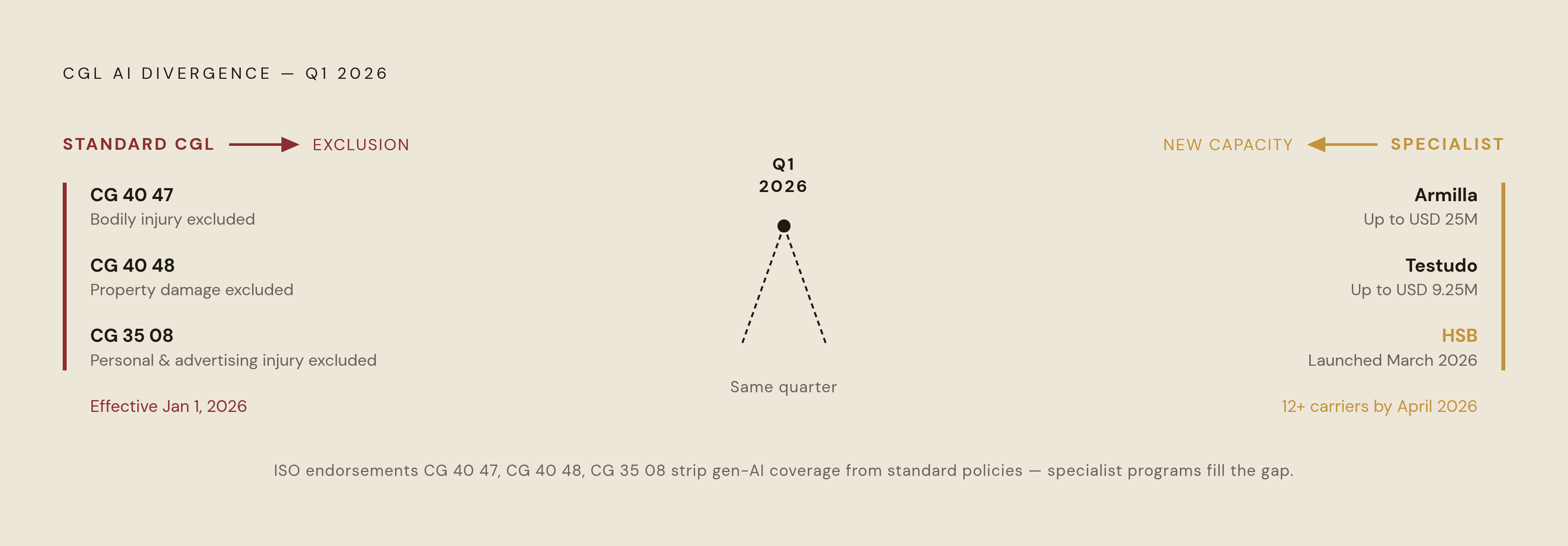
On January 1, 2026, three ISO endorsements took effect, and they quietly redrew the boundaries of commercial insurance for any company building or deploying AI. CG 40 47, CG 40 48, and CG 35 08 strip bodily injury, property damage, and personal and advertising injury tied to generative AI outputs out of standard commercial general liability forms. The first endorsement removes coverage for harm caused by generative AI outputs. The second takes personal and advertising injury claims, including intellectual property and copyright disputes, out of coverage for AI-generated content. The third removes bodily injury and property damage arising from generative AI from the products and completed operations part of the policy, the section that would otherwise respond when a product fails after it leaves the company's hands. AIG, Great American, and W.R. Berkley have all filed exclusion language with state regulators, and W.R. Berkley's version is written broadly enough to cover any claim tied to "any actual or alleged use" of AI, without naming a single tool or vendor.
Companies that assume their coverage hasn't changed are the ones the effect hits hardest. Any policy renewed on or after January 2026 at a carrier using this language may now exclude losses that an identical policy would have covered a year earlier, and the exclusion applies whether or not the buyer noticed the new form. If a company hasn't read its renewal paperwork line by line, it may be operating uninsured for its core AI exposure without knowing it until a claim gets denied.
While the generalist market was closing this door, a different part of the industry was busy building a new one. At least twelve carriers or programs were writing meaningful AI liability limits as of April 2026, and that activity sits concentrated in the US specialty market and at Lloyd's. The products span monoline AI specialists, bespoke Lloyd's programs, and off-the-shelf policies aimed at smaller companies, so the market now has real depth across company sizes, not just a single high-end offering. What happened in 2026 wasn't a slow drift. It was a split: one side of the market walking away from AI risk in the same quarter the other side started building products specifically to price and carry it.
Why standard policies were never built to handle the liability a physical AI system creates
The retreat by generalist carriers wasn't a defensive overreaction. Standard commercial policies were built around a model of liability, and physical AI systems break that model by design. A piece of industrial equipment that behaves the same way every time it runs can be priced against decades of loss history. A physical AI system makes decisions as conditions change, adjusting its behavior based on sensor input, model updates, or environmental variables the underwriter never sees, a pattern that breaks the model completely. The liability doesn't sit with one party in a way a single policy can cleanly trigger.
Consider what happens when a robot malfunctions on a factory floor. The failure can plausibly trace back to the hardware manufacturer, the company that wrote the control software, and the operator that deployed and maintained the system, all at the same time. Because so many policy wordings were drafted before autonomous systems were common, a claim like this can fall into the space between a general liability policy, a tech errors and omissions policy, and a cyber policy, with none of the three clearly obligated to pay. If the policy carries one of the new AI exclusions, or if the loss doesn't match the policy's technical definition of an "accident," coverage may not apply. Even when a standard policy does respond, it typically pays for the physical damage and stops there, leaving out the production losses and downtime that follow when a robot failure takes a line down for days.
Pricing breaks down for the same underlying reason. Insurers have always priced commercial risk using historical claims data, equipment maintenance records, and documented operating controls, and physical AI offers less of the first and more volatility in the rest. A robot's software gets updated after the policy is bound, and its operating parameters shift mid-term in ways no standard policy anticipates. The same physical robot, running the same model, can carry a meaningfully different risk profile depending on which facility it's deployed in, a distinction that conventional rating methods were never built to capture.
Specialist carriers and their capacity
Specialist carriers and Lloyd's-market programs have stepped into that gap with affirmative coverage, meaning policies that state outright that AI risk is covered rather than leaving the question to a court to decide after a claim is filed. A market now exists where none did a few years ago, and it already has visible shape and real capacity behind it.
Armilla operates as a Lloyd's Coverholder and writes up to USD 25 million per insured through a standalone third-party AI liability trigger built directly around how an AI system behaves, covering underperformance, critical errors, hallucinations, or inaccuracies that cause damage. Testudo, also a Lloyd's Coverholder, writes a smaller single-insured limit, up to USD 9.25 million per insured as of February 26, 2026, when Atrium and QBE expanded its capacity. HSB AI Liability Insurance launched in March 2026, covering bodily injury, property damage, and personal and advertising injury arising from AI use; carrier partners distribute it as a packaged product aimed at smaller buyers, apart from frontier deployments. Where a single carrier's limit isn't enough, programs can layer multiple carriers on top of each other to reach materially higher total limits than any one of them offers alone.
Two different kinds of specialist carrier have emerged, and the distinction matters when deciding where to go. Monoline specialists, including Armilla and Testudo, write AI liability as their core business, and their underwriting expertise is built entirely around this one risk category. Extension carriers take a different path and add affirmative AI coverage onto an existing line; Counterpart, for instance, extended its professional liability suite to include affirmative AI coverage rather than building a standalone AI product from scratch. If you run a complex autonomous deployment at a frontier tech company, you'll generally find more tailored terms at a monoline specialist, but if your AI exposure is smaller or simpler, an extension product may be enough and considerably easier to access. If you need the largest limits as an enterprise buyer, bespoke Lloyd's programs remain the route to the highest capacity, but they demand strong supporting documentation, and you can't buy one off a shelf in an afternoon.
The coverage lines a physical AI company needs
No single policy covers AI risk end to end. What a physical AI company actually needs is a coordinated stack of coverage lines, and that stack looks different for a company whose AI systems act in the physical world than it does for a company shipping pure software.
Tech errors and omissions coverage is the line that responds to wrongful acts or performance failures tied to the technology itself, and it fills gaps that general liability and cyber policies routinely leave open. It's the policy that matters when a software error in a robot's control platform cascades into equipment damage, a defective output, or a shutdown across an entire facility. As physical operations and the software that runs them become harder to separate, tech E&O becomes the line holding the rest of the stack together.
Cyber coverage plays a narrower and more specific role. It responds to deepfake fraud, phishing written by AI, and ransomware that leads to a data breach, all genuine AI-enabled attack vectors. What it typically does not cover are losses caused by the insured's own AI output: a hallucinated result, infringing AI-generated content, or a bad autonomous decision. These losses look more like a professional-services error than a network-security failure, and that is where many autonomous-system claims fall between cyber and tech E&O, uncovered by either.
Directors and officers coverage is easy to overlook and shouldn't be. The exposure here comes from management decisions: approving an AI use case, disclosing (or failing to disclose) material AI risk to investors, overseeing a vendor relationship that later goes wrong. A founder who signed off on an autonomous deployment that causes harm, or who left a known AI risk out of fundraising materials, faces personal liability that no product policy or tech E&O policy touches.
Space is a smaller category but a real one for companies running AI compute in orbit. Space insurers already cover launch failures, satellite malfunctions, and on-orbit anomalies, but AI computing satellites bring additional concerns: hardware degradation, radiation exposure, cyber risk, thermal management, and business interruption if the system goes down. Getting credible insurance coverage in place is becoming one of the markers that orbital AI infrastructure has moved from experimental to commercially viable. If you run a hardware-forward company more generally, you need inland marine and equipment coverage too, particularly for systems in transit or installed at a customer's site outside your own walls.
Enterprise and government contract requirements before signing with an AI company
None of this is theoretical once a company sits down to negotiate an enterprise or government contract. Procurement teams embed specific insurance requirements into contract language as a matter of routine, and a company that hasn't built the right coverage stack in advance can find a deal blocked or delayed over paperwork.
Tech E&O minimums in enterprise contracts commonly start in the low millions of dollars per occurrence, and they go higher still in larger contracts. Cyber liability requirements typically set limits per claim and in aggregate, with data-sensitive or large-scale contracts demanding more. Certificates of insurance, additional insured status, and waiver of subrogation are standard procurement asks that appear on nearly every contract of this size, not extras a vendor can talk its way out of, and none of this is negotiable at the point of signing.
Autonomous vehicle and robotics companies face a second layer of requirements, and these sit outside the contract. Nevada, New Mexico, Maine, Maryland, and Washington, along with several other states including Connecticut, Vermont, New Hampshire, D.C., and New York, all set a $5 million insurance threshold for autonomous vehicle testing or deployment. A company that hasn't structured its coverage to clear that bar cannot legally operate in those jurisdictions, regardless of how ready its technology actually is.
Timing is the practical risk. A company that walks into a contract negotiation without specialist coverage already in place has two options: delay the deal while it scrambles to buy a policy, or buy one under time pressure, which almost always means worse terms and a higher premium than the same coverage bought calmly, months in advance. Knowing these requirements before a deal is on the table, rather than discovering them during final contract review, is the entire advantage a prepared company has over one that isn't.
How underwriters evaluate an autonomous-system risk
In the specialist AI market, the underwriting submission is where the real negotiation happens. Premium and coverage terms get set there, and a weak submission produces a worse outcome no matter how sound the underlying technology actually is.
Underwriters can't fall back on historical loss data the way they would for a fleet of delivery trucks, because that data doesn't exist yet at any meaningful scale for autonomous agents. In its place, they look at architectural maturity, third-party security audits, and how often the system has been through adversarial testing. A company without structured AI governance documentation leaves the underwriter to estimate more of the risk itself, and that uncertainty appears in the policy as more attached conditions, more follow-up questions during underwriting, and usually a higher premium or narrower terms than a well-documented applicant would get for the same underlying system.
System observability isn't optional in this market. Policyholders need to show continuous telemetry tracking and automated intervention mechanisms that can step in when the system behaves unexpectedly. Underwriters also require immutable audit logs of every autonomous action the system takes, because when an incident happens, investigators use those logs to pinpoint whether the failure traces back to a prompt injection attack, a flaw in the training data, or an environmental anomaly nobody anticipated. A company that hasn't built these architectural proofs into its system design from the start risks outright denial of coverage, or a premium penalty steep enough to make the policy impractical.
Beyond observability, underwriters commonly look for a documented AI use policy, human-in-the-loop controls at the points where autonomous decisions carry real consequence, vendor due diligence records, documented risk assessments, and in some cases evidence of red-teaming the system before deployment. None of this is a box-checking exercise for its own sake. Each item gives the underwriter something concrete to price against instead of guessing, and a company that walks in with this documentation already assembled controls far more of its own outcome than one that shows up and asks the underwriter to figure it out.
Reaching the Specialist Market
You won't find any of the coverage described above sitting on a standard commercial insurance shelf. Reaching it requires a broker who actually works with Lloyd's and the US specialty carriers writing autonomous-system risk, not a generalist who happens to also sell business insurance.
A generalist broker, working with good intentions, will often slot a frontier tech company into generic forms built for conventional businesses, and the resulting submission won't communicate the system architecture, the governance posture, or the autonomy envelope that a specialist underwriter needs to see before pricing the risk properly. A generalist may also not know that the new ISO exclusion endorsements have quietly removed coverage the client assumed was still in place, and may have no path at all to the carriers that have built products specifically for this risk class.
A broker who actually works this market behaves differently from the first conversation. They read the policy language before anything gets bound, catching exclusions, sublimits, and conditions a generalist would miss. They build the submission around the factors specialist underwriters actually use to evaluate autonomous-system risk: certification posture, autonomy envelope, deployment scope, sector sensitivity, and claims history. And they take that submission to carriers who have explicitly built products to cover autonomy, rather than carriers who simply haven't gotten around to excluding it yet. A submission built with this level of specificity will consistently produce better terms than a generic one built for a conventional business, because it gives the underwriter what they need to price the risk with confidence instead of padding the policy with caveats to cover their own uncertainty.
None of this costs more on the broker's side. Commission is baked into the premium regardless of whether a generalist or a specialist places the policy, so working with a broker who actually knows this market is a coverage decision, not a cost decision. A founder can simply describe what the company builds in plain language, or share a URL, and a broker who knows this territory can draft the full application and route it to the carriers actually positioned to write the risk.