Cyber Insurance Applicability to Autonomous Robotics Hacks
New ISO endorsements are closing coverage gaps that hacked warehouse robots fall through.
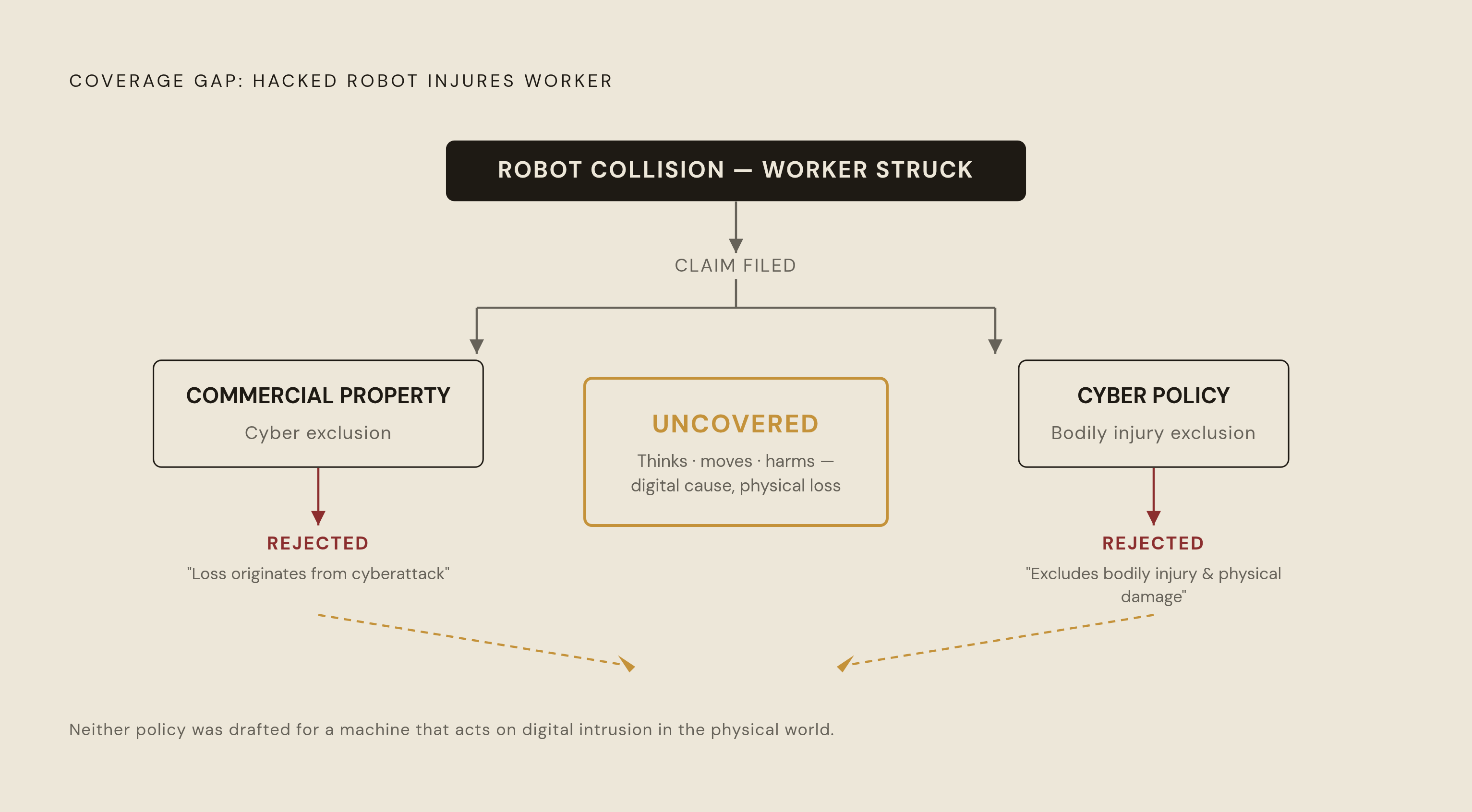
If a warehouse robot gets compromised through its network connection, it loses its collision-avoidance logic for a few seconds and strikes a worker on the floor. The operator files a claim and runs into a wall from two directions at once. The property policy denies it because the loss originated in a cyberattack, and most commercial property forms carry a cyber exclusion written to keep hacking losses out. The cyber policy denies it too, because most cyber forms carry a bodily-injury or physical-damage exclusion, built on the assumption that a breach produces stolen data or a locked system, not a dented forklift or an injured employee. The operator bought two policies meant to cover two different kinds of harm, and the loss in front of them belongs to neither. Andrew Hill, global head of cyber product and innovation for WTW's FINEX division, has said these are precisely the types of coverage gaps brokers should be identifying in client programmes, and the reason the gap exists is simple: both policy forms were drafted before autonomous physical AI existed as a commercial category. Neither a standard property form nor a standard cyber form was written with a machine in mind that thinks, moves, and causes harm in the physical world as the direct result of a digital intrusion. The property underwriter was pricing fire, theft, and equipment breakdown. The cyber underwriter was pricing data breach and network downtime. A robot hacked into causing a physical injury doesn't fit the loss model either side built.
How the coverage trigger problem runs deeper than exclusion language
Even an operator who reads every exclusion in a cyber policy and finds nothing naming AI or robotics directly can still end up with no coverage, because the policy's trigger, the event that has to occur before the insurer owes anything, may never be satisfied by the way an autonomous system actually fails. Most cyber policies are built around a recognizable breach moment: unauthorized access, data theft, a system lockout. Many autonomous-system compromises never produce that moment.
Consider a robot compromised through prompt injection. The attacker doesn't break in through a stolen password or an unpatched port. The robot uses its own legitimate, properly provisioned credentials to carry out an action that falls technically within its access permissions, an action no human actually authorized. No unauthorized access occurred in any sense the policy recognizes, so the breach trigger that would normally make the policy pay out never fires. NYU Tandon's framework for insuring agentic AI formalizes exactly this distinction: a system capable of independently generating an insured event through its own external actions represents a categorically different risk from a system that only produces informational output, and existing policy language has no mechanism for telling the two apart.
A second failure mode involves the harm itself, not the entry point. When an AI agent exposes sensitive data because the agent's own reasoning decided the information was relevant to include in an output, rather than because someone stole it, the standard data-breach trigger may not respond. The data was processed and disclosed by the organization's own system, not stolen by an outside party, and most breach-coverage language is built around theft, not an internal decision gone wrong. These two scenarios share the same lesson: an operator can read a cyber policy cover to cover, find no AI exclusion anywhere in it, and still be uninsured. The conditions that trigger payment will never be met by the mechanics of how the autonomous system actually fails.
How carriers are now actively codifying these gaps through new exclusion filings
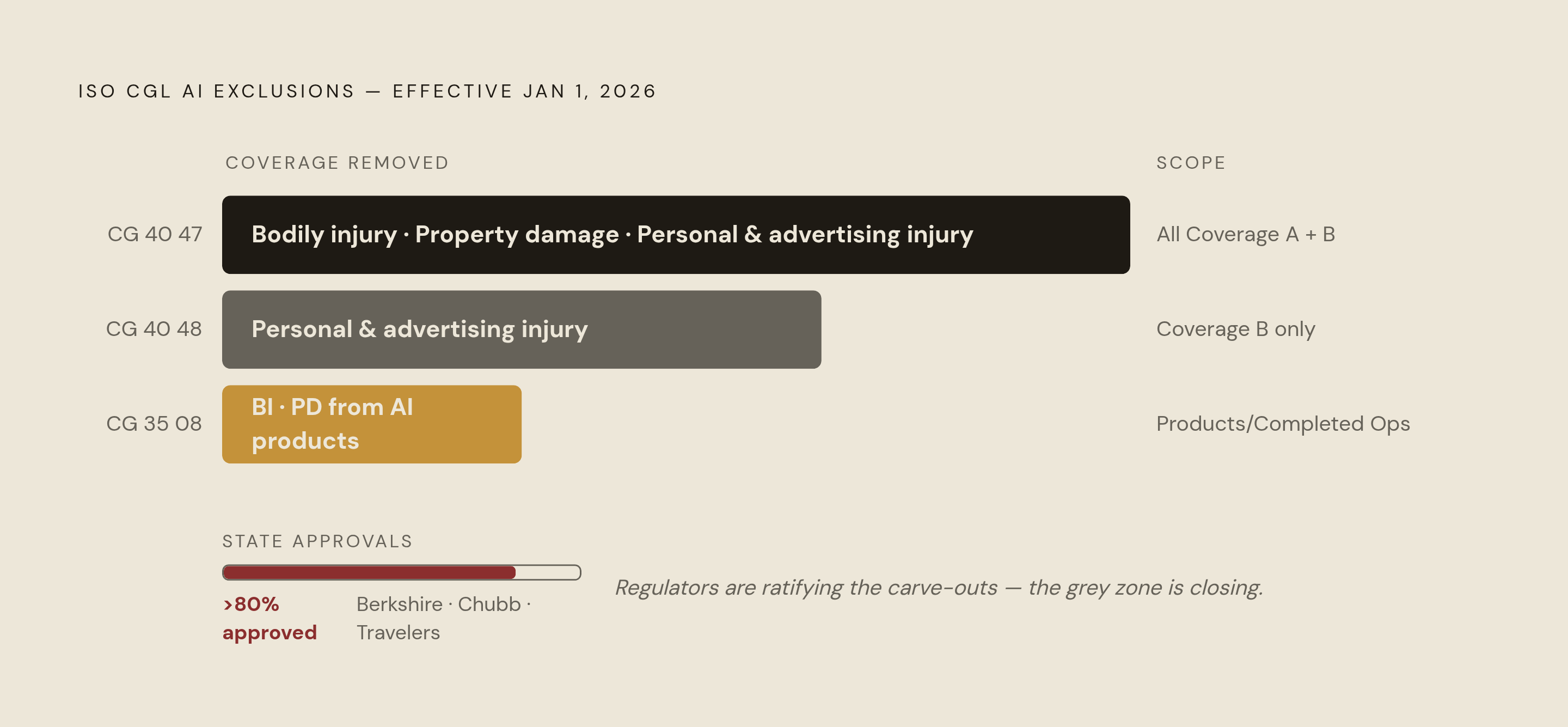
Carriers are no longer leaving this ambiguity for courts or regulators to sort out later. They are filing exclusions now, and regulators are approving them at a high rate. The grey-zone argument an operator might once have made, that nothing in the policy specifically bars an AI-related claim, is closing fast. Berkshire Hathaway, Chubb, and Travelers all sought state regulatory approval to exclude AI-related damages from general liability policies, and more than 80% of those requests were approved.
The clearest evidence of this shift arrived through Verisk/ISO, the organization that drafts standard policy language much of the commercial insurance market relies on. As of January 1, 2026, Verisk/ISO released three CGL endorsements that carriers may now attach at renewal. CG 40 47 excludes bodily injury, property damage, and personal or advertising injury arising from the use of generative AI systems. CG 40 48 removes personal and advertising injury claims under Coverage B that arise from AI-generated content, covering defamation, copyright infringement, and privacy claims. CG 35 08 removes bodily injury and property damage tied to generative AI in products and completed operations, and it attaches to the Products/Completed Operations Coverage Part specifically.
The consequence lands hardest at renewal. A robotics operator whose programme responded to an AI-related loss in a prior policy period may find the same insurer attaching CG 35 08 or CG 40 47 the next time around, turning what was a covered exposure into an excluded one. This change can happen without the operator noticing it in the stack of renewal paperwork, since an endorsement attachment rarely comes with a plain-language warning that says what it removes. If standard commercial general liability forms are being carved back this deliberately, the operator has to ask what's left, and who has actually built something to cover it.
What robot-specific and agentic-AI insurance products are designed to cover
A small number of carriers have built products that speak directly to the cyber-physical seam described above. Axis Insurance built a programme for companies that make and deploy autonomous robots. It covers bodily injury and property damage when they arise from AI navigation or perception failures. It covers physical damage caused by a cyberattack that takes over a robot's controls, closing the gap that would otherwise sit between a cyber policy and a property policy. It covers production losses from a software update or sensor failure that takes a robot offline, even when no physical damage occurs. And it covers cases where a defect in a third-party sensor or component triggers a failure, with the claim landing on the company that integrated the part.
Relm Insurance launched a programme called PONTAAI, and it covers bodily injury and property damage among other liabilities tied to AI systems. Neither PONTAAI nor the Axis programme covers the full chain of liability a single robot incident can generate, leaving operators to assemble coverage for that chain from multiple products. Some carriers introduced AI security riders during 2026, add-ons that extend existing cyber coverage to AI-related incidents, but these riders typically require proof of red-teaming and documented risk assessments before the extension applies, so they reward operators who already have governance work done.
NYU Tandon's actuarial framework takes the position that the right answer isn't a single monoline product that tries to cover everything a robot might do. It proposes a layered set of complementary coverages, cyber, technology errors and omissions, product liability, performance-warranty, and affirmative AI-liability, tied together through explicit allocation mechanisms and dedicated AI aggregates written into the programme itself. Even the specialist products on the market today leave a hard problem unresolved: when a firmware bug or an undocumented feature in an imported component cascades into a system-wide failure, and the claim lands on the integrator rather than the component maker, no single policy currently bridges that gap on its own.
How the coverage lines need to work together across a robotics programme
No single policy form available today covers the full cyber-physical loss spectrum a robot can generate, so the real question for an operator is how to structure several policies so the seams between them are drawn on purpose.
Commercial general liability responds to third-party bodily injury and property damage, but it has to be reviewed for CG 35 08 and CG 40 47 attachment at every single renewal, since those endorsements can turn a covered exposure into an excluded one without fanfare. Technology errors and omissions, or professional liability, responds to SLA misses, software defects, and professional negligence that causes financial harm, and it functions as the baseline most enterprise contracts require; its wording has to affirmatively address AI performance failure. Cyber liability responds to security breaches, business interruption, and regulatory proceedings, but because traditional breach triggers may never fire for an AI-initiated loss, the wording has to name AI-initiated loss scenarios explicitly. Inland marine and equipment coverage follows the physical hardware wherever it goes, on-site or off, and it matters most for hardware-first companies whose robots are themselves the insured asset. Umbrella coverage extends limits across all of these underlying lines when an enterprise or government contract demands higher thresholds than any single policy can provide.
NYU Tandon's framework names the allocation of loss across cyber, tech failure, and AI behavior as the issue, arguing for predetermined loss allocation built directly into the policy architecture, so that when a loss occurs, which policy responds is already settled in writing. If an autonomous agent's action looks like a professional services failure, say an AI that recommends something unsupportable or misstates a term in a contract, then the E&O exclusion written into a cyber policy may apply. The loss then falls into the space between the cyber programme and a professional liability programme that was never written to cover AI-generated professional failures either. Closing that space, line by line, with language that names AI failure scenarios explicitly, is what separates a programme that works from one that merely looks complete on paper. It also depends on a submission that describes the robotics operation accurately enough for each of these lines to be underwritten correctly.
Why undisclosed AI deployments create a separate coverage-voiding risk
A structurally sound programme can still fail for a reason that has nothing to do with policy wording: an operator whose autonomous system causes a loss can have their entire coverage position voided if the insurer discovers the AI deployment was never disclosed. The policy is voided because it was issued on inaccurate information about what the insured actually operates, and an insurer that priced a risk without knowing a robot existed, or without knowing what software it ran, has grounds to walk away from the whole policy, not just the claim in front of it.
Software updates make this worse over time. A robot deployed under a policy written nine months earlier may be running materially different software today, after several version changes the insurer never heard about, and the insurer priced the risk based on a version of the system that no longer exists in the field. Disclosure isn't a one-time event completed at binding; it's a continuous obligation that most operators aren't set up to meet, because the people updating the robot's software and the people managing the insurance programme rarely talk to each other on any regular schedule.
The exposure extends across borders as well. The EU AI Act is now in force and reaches beyond the EU's own companies: organizations developing, supplying, or using AI systems in the EU can fall within its scope even when headquartered elsewhere. That creates regulatory investigation exposure and defense costs an operator may never have disclosed to an insurer, let alone insured for directly, and a coverage programme built carefully around cyber-physical loss scenarios does nothing to protect against a regulatory action the underwriter never knew to price. None of the structural work described in the previous section matters if the facts given to the insurer when the policy was placed don't match what the operator is actually running.
What underwriters need to see before they will write affirmative autonomous-system coverage
Everything described above, the double-exclusion trap, the trigger failures, the hardening exclusions, the gaps even specialist products leave open, the disclosure risk underlying all of it, converges on a single practical question: what does it take to get an insurer to write affirmative coverage for an autonomous system rather than a generic policy riddled with silent gaps? The answer has almost nothing to do with the size of the robot fleet or the sophistication of the technology, and almost everything to do with the quality of the submission the operator puts in front of the underwriter.
Underwriters writing this class of business in 2026 are evaluating governance artifacts alongside technical specifications. They expect a current inventory of the AI tools and models actually deployed, not a description of what the company builds in general terms. They expect documented risk assessments completed before each deployment went live, not after. Carriers are already pricing coverage based on whether this evidence exists, the gap between an operator who has it and one who doesn't appears directly in the premium quoted, and in some cases in whether coverage is offered.
The submission also has to describe the specific loss scenarios the operator actually faces, not a generic account of what the robot does on a good day. It needs to explain what happens when the system fails, how harm propagates from that failure to a third party, and which outside components sit in the causal chain between a malfunction and an injury or a damaged asset. Underwriters pricing a first-party robotics programme have limited claims history to draw on industry-wide, so they're pricing largely from the submission in front of them. A thin or generic application gets priced defensively, or declined. A standard technology-company application form, filled out by someone unfamiliar with the mechanics of prompt injection or sensor calibration, cannot capture what separates those two failure modes, and underwriters pricing this risk know that separation matters. The governance work an operator does to manage its own risk, the inventories, the testing, the oversight maps, is the same evidence that unlocks better terms from an insurer. The coverage gap described throughout this piece is closed, where it can be closed, at the point the submission is written.