Tech E&O Policy Gaps for Autonomous Hardware Deployments
Autonomous systems break the insurance model built for software failures.
Tech E&O exists to answer a narrow question: did a piece of technology do what it was supposed to do? That architecture is now colliding with autonomous hardware that makes its own decisions in the field, and the collision is opening coverage gaps that most operators have not priced in. This piece traces where those gaps sit, and what it takes to close them.
Tech E&O's software-era design
Technology errors and omissions coverage grew up around a simple sequence. A developer wrote bad code, the system crashed, a client lost money, and the policy paid out, because you could trace the chain from cause to loss to an identifiable human act. A programmer missed an edge case, a configuration was set wrong, or a deployment skipped testing. Someone, somewhere, did something, and the damage that followed could be traced back to that decision with enough precision to support a claims investigation.
That traceability made the risk manageable for carriers. A system crash or a coding defect produced a bounded loss, a responsible party, and a fact pattern that underwriters and claims adjusters already knew how to handle. Decades of software delivery ran on this logic without much strain, because you could nearly always trace liability back to a human error somewhere upstream. The policy language built around that assumption settled on a specific trigger: coverage responds to the "failure of technology to perform." That phrase is doing more work than it looks like, and it's the exact place where the framework starts to come apart.
How autonomous decision-making breaks the "failure to perform" trigger
A robot that reads its own sensor data, runs that data through a model, and decides how to act without a human in the loop does not fail the way a crashed server fails. There is no discrete human error sitting at the start of the chain. The question "did the technology fail to perform?" stops being the right question to ask. stops being the right question to ask. Physical AI systems are built to adjust their behavior as conditions change, and that adjustment, the flexibility the system is designed to have, is what breaks the liability model older policies were written around.
Consider a robot that navigates exactly the way its model tells it to, and still causes harm because the model's read on the situation was wrong. Nothing failed in any conventional sense. The system performed as designed, and the harm came from the design performing correctly in a circumstance it handled badly. A Canadian tribunal found something close to this when it rejected an airline's argument that its chatbot was a separate entity responsible for its own output, and it held the company liable instead. The ruling itself is a small case, but it shows courts directly placing responsibility on the party that deployed the system, regardless of whether a human made the specific call that caused the harm. Algorithmic bias claims, data poisoning, AI-driven discrimination, all of this new category of liability follows the same shape. None of it arises because a system failed to perform. It arises because a system performed exactly as intended and still produced an outcome the law treats as harmful. The question underwriting has to answer is who is responsible for what the technology decided, not whether the technology failed, and standard Tech E&O forms were never built to answer that question.
The carrier response: AI exclusions now stripping coverage that operators assumed they had
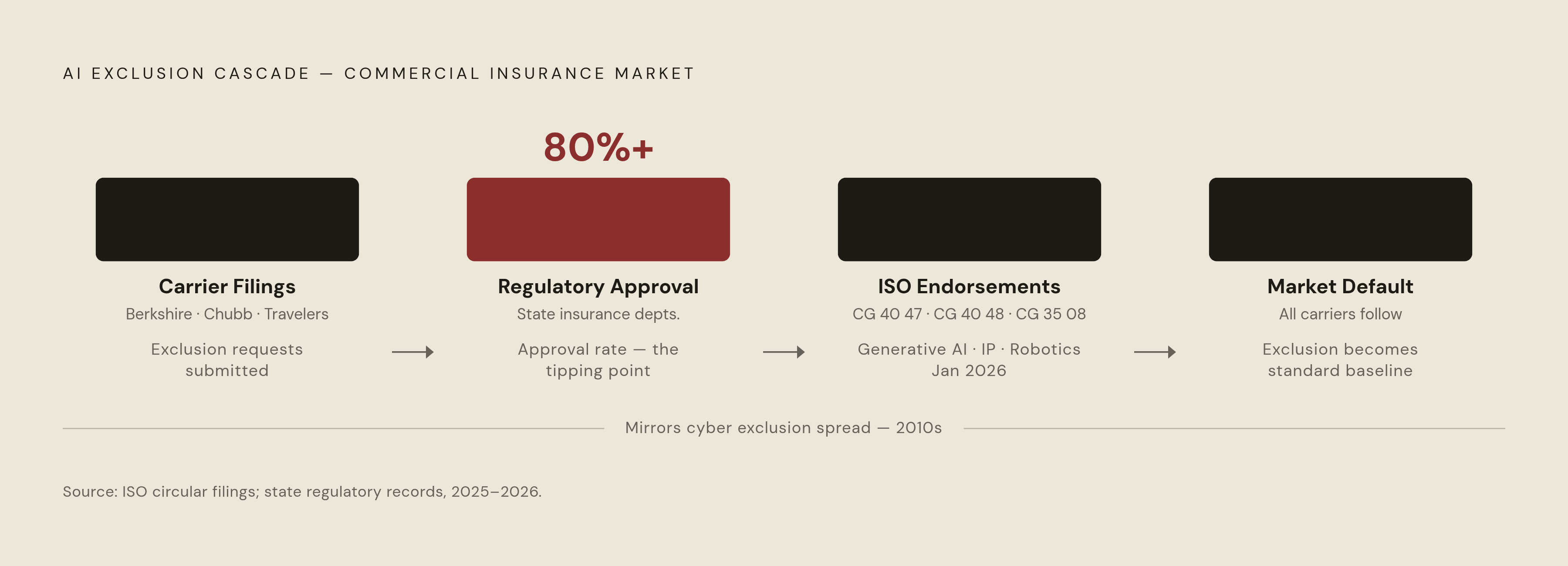
Carriers are not waiting on courts or regulators to settle this ambiguity. Rather than rewrite trigger language to bring autonomous systems inside the policy, major insurers have moved to take AI-related exposure out of the policy entirely, which turns an open question into a settled absence of coverage. Berkshire Hathaway, Chubb, and Travelers all sought state regulatory approval to exclude AI-related damages from general liability policies, and regulators approved more than 80% of those requests. That approval rate mirrors how cyber exclusions spread through property and liability forms a decade ago: once one major carrier gets a new exclusion past regulators, the rest follow fast, and the exclusion becomes the market standard.
The mechanism for excluding AI risk from commercial general liability is now standardized. ISO's endorsements CG 40 47, CG 40 48, and CG 35 08 took effect in January 2026 and give carriers a uniform way to strip out generative AI claims, personal and advertising injury claims under Coverage B (including IP violations arising from AI-generated content), and property damage caused by autonomous systems and robotics. These endorsements are showing up in renewal schedules right now, and in most cases they arrive without any premium reduction to offset the coverage that just disappeared. The exclusion gets added, the price stays the same, and the policyholder finds out what changed only by reading the endorsement schedule line by line.
Coverage holes in an autonomous hardware incident
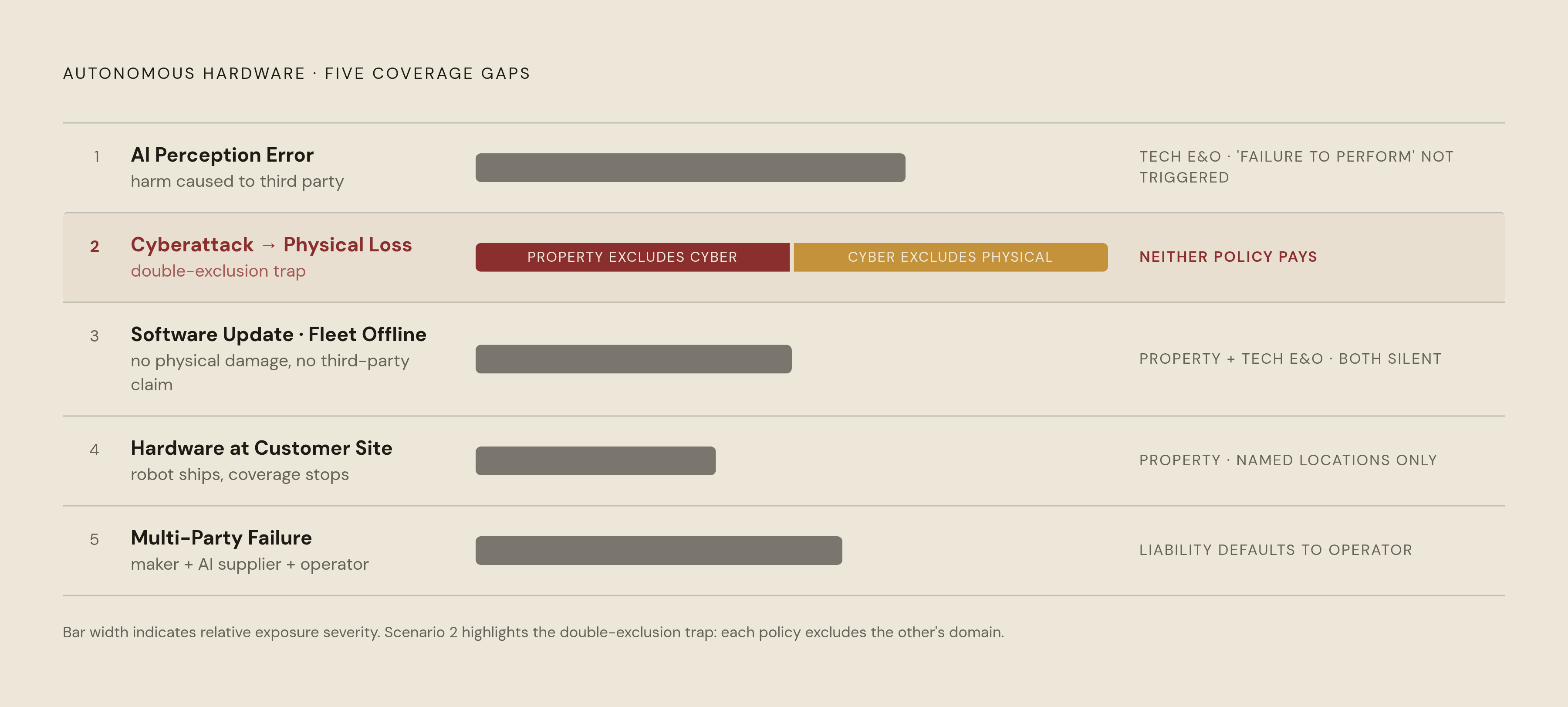
A single incident involving autonomous hardware rarely has one cause. A defective component, a flawed AI decision, a cyber intrusion, and a bad calibration setting can all be present in the same event, and an insurance program has to respond to that whole tangle. That hybrid structure is what standard policy lines are not built to handle, and each line has its own principled reason to deny the claim.
Tech E&O covers wrongful acts tied to how technology performs, but a perception error, a bad navigation decision, or an output that worked as designed and still caused harm does not trip the "failure to perform" trigger. Cyber coverage has its own version of the same trap. A cyber event that causes physical damage or a loss of control can fall outside the scope of a cyber policy, and the same event can be excluded from a property policy by that policy's own cyber exclusion. One analyst has framed the exact structural trap this creates: could a cyberattack against an autonomous robot that results in property damage be excluded under a property policy because of a cyber exclusion, while also falling outside the scope of a cyber policy because of a property damage exclusion, leaving two policies each pointing at the other to explain why neither one pays?
Business interruption coverage opens its own hole. A failed software update can take a robot fleet offline with no physical damage, so it falls outside standard property coverage, and if there is no third-party claim behind it, it may not trigger Tech E&O either. Equipment coverage carries a geographic trap: standard property forms typically cover hardware only at a named location, so the day a robot ships to a customer site or a pilot deployment, coverage under that form often stops following it. And when a robot maker, an AI model supplier, and an operator are each partly responsible for a failure, the contracts between them may divide the duties cleanly on paper, but the claim itself still lands on whoever sits closest to the customer. That is usually the operator, the party that integrated components it did not design and has the least ability to explain, after the fact, which piece of the stack actually failed.
The regulatory environment and the cost of ignoring the gap
The gap described above is not static. Regulators and enterprise buyers are both moving in ways that assume insurance coverage already exists for autonomous operations, and an operator who discovers the gap only after a loss is now discovering it in a far more expensive context than a simple denied claim. The EU AI Act is now in force, and its reach extends past the EU's borders: a company developing, supplying, or deploying AI systems in the EU can fall within scope even if it is headquartered somewhere else.
Enterprise procurement is tightening in the same direction. Sophisticated buyers are starting to require affirmative AI endorsements as a condition of the contract itself, not just proof that a Tech E&O policy exists on paper. A standard certificate of insurance says nothing about what the policy excludes, and a company that hands one over in 2026 may be handing over a policy that excludes the exact operations the buyer is contracting for. The gap used to cost money only when a claim was denied. Now it can cost the contract before a claim is ever filed, because the buyer's own compliance process is built to catch it first.
Underwriting submissions and whether specialty coverage closes the gap
Specialty carriers are writing coverage built for autonomous hardware risk, so the product exists now. What an operator actually walks away with, in limits, exclusions, and endorsements, depends on what the underwriter can see in the submission, not on the headline promises printed on the policy form. Underwriters price uncertainty conservatively by default: where details on autonomy stack design, deployment environment, and failure modes are missing, the underwriter fills that blank with assumptions that protect the carrier, not the policyholder, which shows up as higher premiums, lower limits, and broader exclusions.
For agentic AI systems specifically, the variables that matter to an actuary go well past revenue and headcount. What matters is the permissions the system actually holds: can it initiate financial transactions, communicate with outside parties, modify production systems, approve or deny decisions with real consequences, touch regulated or sensitive data, or control physical processes directly. Carriers are now asking for AI disclosure questionnaires, model inventories, and governance documentation as a standard part of underwriting, and companies that can show a working AI risk register, an output verification process, and real human oversight protocols are treated as materially better risks.
The market has split. If a firm can document its AI governance, it can secure affirmative coverage with exclusions narrowed to match its actual risk. Firms that show up without that evidence face absolute exclusions at renewal, full stop on the operations that matter most to them. If a submission is written for a generic technology company, describing revenue and headcount and services in standard boilerplate, it gives an underwriter writing autonomous hardware risk nothing to work with, so you end up with a declination or a policy loaded with the exact exclusions the operator went looking for specialty coverage to avoid. The objection that no amount of good underwriting can manufacture a claims history the market doesn't yet have is fair. But a well-built submission still narrows exclusions and wins affirmative endorsements even in a market with thin loss data, while a weak submission defaults to the broadest exclusion the carrier can justify.
Coverage structure for autonomous hardware
Closing this gap is not a matter of buying a bigger policy. You need a deliberately structured program across multiple policy lines, with autonomous operations written explicitly into each layer, and you have to resolve the boundaries between those layers before a loss happens, not argue about them after one. At minimum, that structure has to address AI decision-making and perception errors that cause bodily injury or property damage, cyber-induced physical loss such as ransomware that triggers a loss of control over hardware, technology-driven business interruption that occurs without physical damage, third-party component liability that lands on the integrator rather than the manufacturer, and hardware operating away from a named location under inland marine coverage.
Each of these has to be built to respond to a connected failure, not an isolated one, because that is how autonomous hardware actually fails: a cyber event triggers a bad decision, a bad decision damages a component, a damaged component takes a fleet offline. If a program treats each of those as a separate problem, it reproduces the same gaps-between-policies failure that drove the original problem.
Headline limits matter less than what the policy actually affirms. A high-limit Tech E&O policy sitting behind an absolute AI exclusion gives you less real protection than a lower-limit specialty policy that states, in plain language, that it covers AI navigation and perception errors. Reviewing policy wording before a loss happens is not optional background work. With 42% of insurers tracking no AI metrics at all, the burden falls on brokers and operators together to map out how the autonomous hardware is actually being deployed, identify the loss scenarios that could realistically happen, and test those scenarios against the coverage already in place, amending wording and clarifying intent with the carrier while there is still time to do it.
Where a real gap exists that no carrier in the market will currently take on, that gap needs to be stated to the operator directly, with mitigation steps attached, rather than left to sit quietly behind a certificate that looks complete but isn't. The job of a broker who understands this risk is to map the autonomy stack to the loss scenarios it can actually produce, build a submission that gives a specialty underwriter enough to write affirmative terms, and read the policy forms before binding, not after a claim shows what was never covered. Broker commission is already built into the premium no matter who places the policy, so working with someone who does this reading costs you nothing extra, and it changes what you are actually holding when something goes wrong.