How Underwriting Algorithms Classify Autonomous Vehicle Manufacturer Liability and Where Carrier Appetite Actually Lives
Insurers are sorting AV liability by software version and operating domain.
An insurance broker for autonomous systems and robotics companies should be able to translate SAE level, operating limits, software history, and telemetry into a submission that specialist carriers can underwrite. For autonomous vehicle manufacturers, genuine capacity depends on that classification work and policy language addressing autonomous operations. The decisive distinction is whether the insurer understands and accepts the exposure the manufacturer actually creates.
Why AV manufacturer liability does not fit the frame standard insurance was built around
Standard auto insurance was built around a human driver who could be held responsible and whose errors and behavior a carrier could underwrite. Autonomous driving changes that starting point because an accident may originate in a system’s design. The liability target has moved toward the manufacturer. Yet the operator may still be responsible for maintenance or decisions about deployment, so automation can leave more than one party liable. It creates a division of responsibility that an insurance classification must represent.
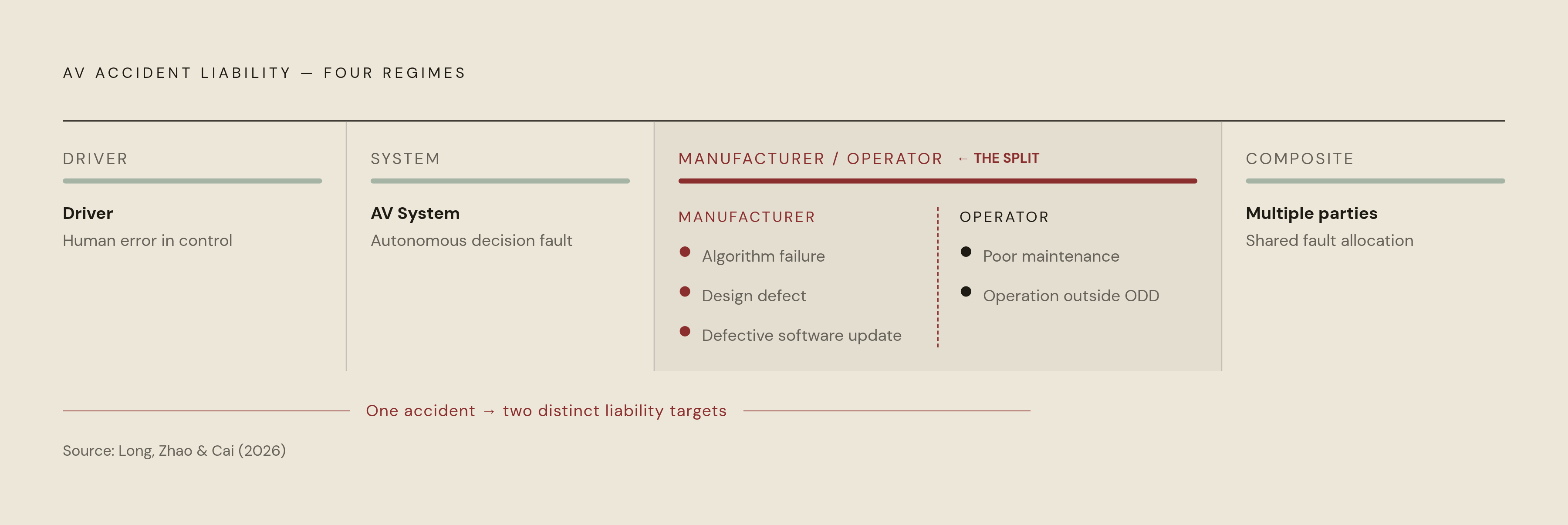
Long, Zhao & Cai (2026) identify four liability regimes in use globally, namely driver liability, system liability, manufacturer/operator liability, and composite liability. Their manufacturer/operator model makes the division especially clear. Damages resulting from algorithmic problems, design flaws, or defective software upgrades should be recoverable from the manufacturer once the operator has indemnified the victim. Inadequate maintenance or operation outside the operational design domain instead places responsibility on the operator. Coverage therefore depends on what caused the failure as well as who owns the vehicle.
Legal scholarship also proposes a “computer driver” standard under which a manufacturer would be liable when its system fails to avoid an accident that a reasonable, competent, unimpaired human driver would have avoided. No legislature has adopted that standard or an equivalent. Underwriters consequently cannot assume a uniform legal test for system performance, and differences between jurisdictions complicate the initial classification.
How SAE level functions as the primary input to underwriting classification — and why it is insufficient on its own
SAE automation level is the first variable an underwriting algorithm reaches for because it roughly identifies who controls the vehicle. At L2, that responsibility rests with the human driver, while at L4 and above, the manufacturer’s system performs the driving function. This provides a preliminary classification of legal responsibility. The SAE L0–L5 taxonomy gives developers and underwriters a shared vocabulary. Without that vocabulary, a submission lacks the basic description needed to classify the exposure.
The label alone is too coarse for pricing. Two L4 vehicles can be very different in their operational design domain, sensor architecture, and how mature their software is. The operational design domain, or ODD, describes the operating conditions that make the automation designation meaningful to an underwriter. A geofenced urban robotaxi traveling at low speed on mapped streets has a different exposure from an L4 highway trucking system traveling at speed through changing weather. Both receive the same SAE designation, but they do not present interchangeable risks.
The large majority of U.S. states have enacted some form of AV legislation, but their standards vary widely, and there is no unified federal framework as of 2026. Some states require a human physically present and able to take control. Texas Transportation Code § 545.454(a), by contrast, identifies the automated driving system as the operator when it is engaged. An underwriting classification must therefore distinguish the system’s technical capability from the legal role assigned to it.
Evidence is a separate constraint on that classification. Long and colleagues identify underdeveloped evidence-production and fact-finding mechanisms as a structural dilemma across all four liability regimes. The data needed to substantiate an underwriting classification may not yet be legally required to exist. A manufacturer’s SAE designation therefore cannot substitute for documentation showing how its system operates within its stated limits.
How fault-attribution logic and the OTA update problem complicate the classification after it is made
Correctly identifying SAE level and ODD does not settle who will be responsible after a loss. The responsible party may be the vehicle manufacturer, software developer, operator, entity that last updated the system, or some combination. Products liability, negligence, and vicarious liability can all apply in AV litigation. The distinction affects which policy responds to the claim.
A software defect may leave the manufacturer liable under products coverage, while operation outside the ODD may leave the operator liable under general liability or auto coverage. Those are not automatic coverage outcomes, because the applicable policy language still governs. Fault attribution therefore needs to be part of underwriting, before a claim is made. Telemetry access is consequential because the classification must be plausible before an incident and supportable afterward.
Over-the-air updates introduce a second source of instability. A carrier pricing a fleet on software version 4.2 may face a materially different risk after the fleet updates to version 4.3 overnight. Perception algorithms, planning heuristics, and control parameters can change between renewals without a corresponding change in the vehicle’s broad automation designation. The insured hardware may remain the same.
Traditional annual policy terms assume that the exposure will stay roughly the same, but autonomous driving software can change during the term. No standard policy form yet provides a mechanism to track, flag, or re-rate on OTA version changes. This leaves a gap between the classification made at inception and the system operating when a loss occurs. Software version history is therefore more than a technical attachment to a submission. It helps define the exposure an insurer is being asked to hold over time.
What the ISO AI exclusion endorsements do to AV manufacturer coverage on standard forms
ISO introduced CG 40 47, CG 40 48, and CG 35 08 effective January 1, 2026, giving insurers exclusion language for losses arising out of generative artificial intelligence. Autonomous systems remain unnamed as a separate excluded category in these endorsements. Their presence does not establish that every autonomous-driving claim is excluded simply because the vehicle uses AI. Whether the exclusion applies still depends on how the claim relates to generative AI and what the wording says.
CG 35 08 applies the generative-AI exclusion to the products and completed-operations coverage part, while the other endorsements address CGL coverage. These changes make renewal wording consequential for manufacturers whose activities intersect with the exclusions. A standard GL policy renewed after January 1, 2026 may remove coverage required by enterprise customers without changing the certificate of insurance. The certificate can show limits while omitting the exclusion that applies.
The movement toward AI exclusions is large and accelerating, but much of the admitted market remains silent rather than affirmatively covering AI or filing exclusions. Silence is not an affirmative grant of coverage. A carrier without a filed exclusion may simply not have introduced one yet, and a generic quote does not establish how the policy will respond to an autonomous-system loss. The practical distinction is between coverage supported by the wording and coverage inferred from the absence of a visible restriction.
Absolute wording has been introduced for D&O, E&O, and fiduciary liability that excludes claims arising from any actual or alleged use, deployment, or development of AI. Such language is broader than the ISO generative-AI endorsements. Management liability for decisions about AV deployment may therefore also be uninsured under generic forms. A manufacturer cannot assume that a gap in operational coverage is repaired elsewhere in its insurance program.
Where carrier appetite actually concentrates — and what separates genuine capacity from a generic quote
Genuine appetite concentrates among specialists that have written classification rules for autonomous operations into their forms. Their approach differs from placing an AV manufacturer into a generic admitted-market category. The distinction appears in the underwriting questions asked. When underwriters ask for ODD certifications, software version history, regulator-mandated crash reporting data, and real-time telematics, they are trying to understand the actual exposure. A quote that requires none of those inputs gives little basis for concluding that autonomous operations have been meaningfully classified.
Specialists also treat the coverage lines as interlocking. General liability, tech E&O, cyber, inland marine for sensor stacks and high-value hardware, and product recall address different parts of an exposure that rarely stays within one line. Tech E&O is particularly significant because AV-specific AI failures, including model errors, planning algorithm faults, and ODD boundary violations, are likely to be pursued against manufacturers there. It is also where specialists are actively developing AI-specific language.
A software defect distributed through the same OTA update can affect an entire fleet. That exposure requires purpose-built coverage language addressing how a conventional products claim would capture the event. The update mechanism changes the scale of the exposure. It also ties the underwriting of software releases to coverage for consequences beyond the immediate accident.
California’s DMV requires manufacturers that test on public roads to show they have $5 million through insurance, a surety bond, or self-insurance under Vehicle Code §38750 and the associated regulation. The CPUC requires the same amount for its AV passenger-service program participants. These requirements establish a substantial financial threshold in an active deployment market. They already exceed what most generic commercial auto programs are structured to provide. Meeting the amount, however, does not establish that the wording addresses the manufacturer’s autonomous operations.
Even specialist underwriting remains constrained by the available data. There is currently no underwriting model capable of producing reliable, repeatable results for AV exposure in primary commercial auto or excess GL/Products. Carriers rely on documents from clients, public data, and their own judgment because they have no fully settled actuarial classification to use. That limitation explains the intensity of their information requests. A specialist needs enough information to generate a price and enough evidence to defend its underwriting position.
What must a submission contain, and how should an AV manufacturer choose an insurance broker?
For manufacturers seeking specialist capacity, the practical task is to make the exposure defensible in a submission. At a minimum, the documents must include SAE level and ODD certification, software version history including OTA updates, and regulator-mandated crash reporting data. Telematics should show when the system is engaged and how the sensors perform. Client contracts must also make the allocation of liability clear between the manufacturer, operator, and software subcontractors. These materials connect the technical description to the responsibilities the insurer is being asked to cover.
The AI-decision layer requires a further body of evidence. Leading-edge underwriters scrutinize training dataset quality and documentation, model validation and testing, explainability of outputs, bias testing, and audit trails. These records document both capability and governance. They give a specialist material it can present to reinsurers as evidence of risk management. Without them, the carrier may be unable to distinguish a well-documented exposure from one whose uncertainty requires a broad price or a declination.
Submission quality consequently influences both premium and coverage outcome. An account built for the manufacturer gives the same carrier more to work with than a generic application. The distinction also reaches the manufacturer’s customers. Enterprise and government contracts increasingly require proof that policy language affirmatively addresses autonomous operations, rather than a certificate showing apparently adequate limits. Procurement review can therefore expose a mismatch that was not apparent when the quote was accepted.
An insurance broker for autonomous systems and robotics companies must know how to use the required documents to meet specialist underwriting requirements and secure the right form language. For an AV manufacturer, the relevant criteria are the ability to structure the submission, identify exclusions, explain how the coverage lines fit together, and reach carriers that classify autonomous operations explicitly. The choice depends on the broker’s ability to make the manufacturer’s particular exposure legible to the market that will accept it.
A manufacturer can begin that process by describing what it builds or sharing its URL so that a broker can draft a purpose-built submission from public information. That starting point supplements internal software, telemetry, governance, and contractual records while reducing the burden of assembling the case and directing it to suitable specialists without requiring the founder to become an insurance expert. Broker commissions are already embedded in the placement, so this submission work costs nothing beyond the premium.