The Signal Hierarchy Underwriting Algorithms Follow When Parsing Autonomous Hardware Manufacturer Risk
Insurers now rank autonomous hardware submissions by product architecture, sensor validation.

Underwriting submission quality for autonomous hardware depends on presenting evidence in the order algorithms evaluate it, beginning with product liability architecture, then sensor validation, software version discipline, operational boundaries, and contracts. These signals act as gates. A strong submission makes each gate legible, helping determine both the premium and whether coverage responds when an autonomous system causes harm.
Why the liability chain for autonomous hardware breaks the actuarial models built for human operators
A demographic proxy built to price a 25-year-old driver has no equivalent in a system with no age, distraction history, or fatigue. When a human operator causes harm, the liability chain runs through the driver, employer, and insurer. Actuaries have priced that sequence for decades. Age, driving history, and distraction patterns help distinguish one human-operated exposure from another, but they cannot explain why an autonomous system made a damaging decision.
Liability runs through sensor reliability, software version history, training data quality, and edge-case validation records. The question changes from who was operating the equipment to which part of the autonomous system failed, under what conditions, and with whose contribution. A manufacturer's records must make those distinctions readable. Without them, the insurer cannot connect a physical loss to the technical decisions that produced it.
Most deploying firms do not maintain those records in a form insurers can evaluate, while most actuaries lack established frameworks for evaluating them. That mismatch precedes any calculation of premium. Underwriting algorithms have begun building a signal hierarchy to make up for this mismatch, using records of controls and how systems operate where standard risk categories offer little help.
What standard policies were built to cover and where they leave autonomous hardware exposed
Standard commercial general liability covers bodily injury and property damage from business operations, but its forms were not written for the specific ways autonomous hardware can fail. A physical product does not make every resulting expense a GL loss. Recall expenses are a clear example of the gap. Consumer notification, retrieval logistics, disposal, and replacement inventory are excluded, even though a recall can be the first and most expensive consequence of a product failure at scale.
A failure in code or system logic can cascade into equipment damage, defective output, or a facility-wide shutdown. GL looks for an “occurrence,” while technology errors and omissions insurance addresses wrongful acts tied to technology performance. Those are different routes into a claim. A submission that describes only the machine's physical function leaves the insurer without a clear account of how its decision-making software could cause the loss.
The machine's location creates another distinct exposure. Inland marine is the natural home for physical autonomous hardware moving between company premises and customer sites. AI-driven underwriting can validate high-value transit and storage locations against peril exposure zones, allowing more accurate pricing for mobile equipment. Automation level also changes where liability lands. At SAE Level 4 and Level 5, much or all of the liability shifts to the manufacturer or operator, making coverage more complex and raising the limits needed, while many states set high per-occurrence minimums for Level 4 operators.
How AI exclusion filings are actively narrowing what any policy will cover for autonomous hardware makers
ISO/Verisk introduced three generative AI exclusion endorsements for commercial general liability, CG 40 47, CG 40 48, and CG 35 08, effective January 1, 2026. Their language is broad enough to bar AI-related claims even when AI is only a contributing factor. The distinction is consequential for integrated hardware. An autonomous product's physical involvement in an accident does not remove the need to examine whether an exclusion reaches the software's contribution.
Berkshire Hathaway, Chubb, Travelers, AIG, Tokio Marine Holdings, W.R. Berkley, Great American, and Fairfax Financial are among the carriers now filing AI exclusion forms. The restriction is not confined to GL. W.R. Berkley has applied an “absolute” AI exclusion across D&O, E&O, and fiduciary liability lines, reaching actual or alleged AI use, deployment, or development by connected people or entities. That language is not limited to generative AI. For a hardware manufacturer, it can create a gap around board-level decisions about AI deployment as well as technology-related claims.
Yet the majority of policies still say nothing about AI, and no court has yet interpreted these exclusions. The lack of an explicit AI exclusion does not prove that a policy covers the autonomous-system loss in question. To judge coverage, insurers must read the policy language as well as check which coverage line the declarations page names.
HSB launched AI Liability Insurance for small and mid-size businesses in March 2026 with standard limits that are modest. Larger vendors can access higher-limit products, although available limits remain well below litigation exposures already materializing in the market. Cyber has largely moved toward affirmative coverage for autonomous-system vulnerabilities. That direction is useful, but each policy still needs to be assessed for the specific vulnerabilities and losses it includes.
The signal hierarchy underwriting algorithms follow when they parse an autonomous hardware submission
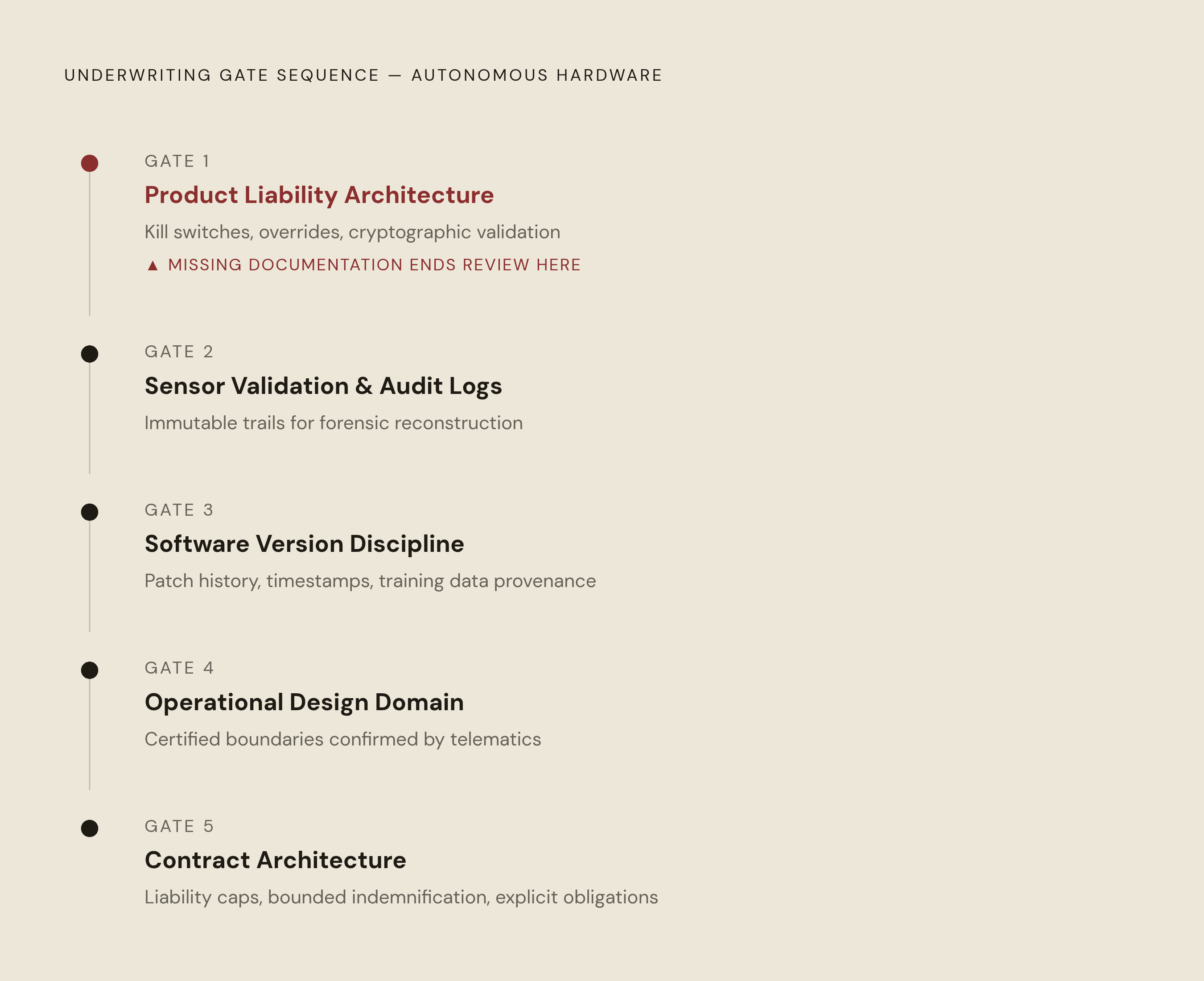
The first signal is product liability architecture. Algorithms evaluate whether the design separates the decision-making layer from raw hardware access and whether deterministic safeguards are documented and verifiable. Those safeguards include hard-coded kill switches, manual override protocols, and cryptographic validation of critical operations. Missing architectural evidence can cause a submission to be flagged as an uninsurable hazard before later strengths receive consideration.
That underwriting threshold is distinct from a universal legal requirement. Some underwriters in 2026 treat a missing kill switch or manual override protocol as a significant risk factor, but no enacted law or universal policy standard mandates coverage voidance on that basis. Insurers also distinguish deterministic software routines from probabilistic neural networks. Probabilistic models receive higher risk ratings because their outputs cannot be mathematically predicted under every fringe condition.
The second signal is sensor validation records and audit log integrity. After physical damage, forensic investigators use immutable records of autonomous actions to work out who was at fault and pursue subrogation against third-party model providers. Granularity becomes central to the insurer's ability to reconstruct events. Organizations without execution trails can lose access to competitive markets at renewal as well as first placement. As in OT cyber underwriting, missing control evidence is a risk signal.
The third signal is software version discipline. Algorithms evaluate the track record of particular system versions, including timestamps of vehicle status and software configuration when an incident occurred. A broad promise to maintain the software cannot take the place of those records. The manufacturer needs version-controlled evidence to show that a patch or update did not cause the disputed failure mode.
The fourth signal is the operational design domain, or ODD. It defines where and under what conditions the system is certified to operate, while real-time telematics show whether it stayed within those boundaries during an incident. NHTSA-mandated crash reporting supplies a baseline input, but the manufacturer's ODD documentation determines coverage applicability. For Level 4 operators, many states require that documentation as a condition of operation, and carriers require it for coverage. Using the system outside the documented domain can leave it without coverage, and even a well-defined domain cannot make up for missing kill-switch documentation earlier in the hierarchy.
The fifth signal is contract architecture. Algorithms assess whether liability caps are calibrated to policy limits, indemnification obligations are bounded, and customer contracts clearly define the product's obligations. Unclear scope language often leads to Tech E&O claims and is a red flag that underwriters can see in the submission. This final tier connects what the system is designed to do with what the manufacturer has agreed to answer for.
What makes a strong insurance submission for an autonomous hardware company
A strong submission presents each tier as usable evidence rather than leaving an underwriter to extract it from scattered attachments. Algorithms compete on the speed and accuracy with which they turn broker submissions into pricing data. Missing fields, ambiguous language, and unsuitable structure can lead to penalties or return of the submission. A control that exists operationally but is absent from the submission cannot support the assessment.
McKinsey estimates that underwriters spend 30–40% of their time on administration, including rekeying submission data. Rebuilding records by hand and relying on paper records work poorly for specialty autonomous hardware underwriting. For Tech E&O, liability cap calibration, indemnification scope, and obligation definition must be explicit. Burying them in an MSA appendix risks an assessment that treats those protections as absent.
A well-structured submission also demonstrates why the coverage program needs more than a general liability label. It distinguishes bodily injury and property damage from technology-performance claims, recall expenses, mobile equipment exposures, and autonomous-system cyber vulnerabilities. It then connects those exposures to the applicable policy language, limits, and exclusions. The objective is not simply to show that several policies exist, but to make the boundaries between them readable.
Coalition and Cowbell provide a benchmark through real-time signal models that can quote and bind in minutes using live, structured signals. Underwriting for autonomous hardware is moving toward the same model. Structured evidence helps manufacturers get competitive prices sooner. A machine-specific submission can outperform a generic commercial submission on premium and coverage terms because it exposes architectural maturity at each gate, rather than asking the algorithm to average vague assurances.
What a manufacturer should do before the submission reaches an underwriter
Before approaching carriers, the manufacturer should assemble attachable records of kill-switch design, manual override protocols, and cryptographic validation layers. Those records should not need reconstruction after an inquiry. The submission should make the separation between autonomous decision-making and raw hardware access clear enough for the insurer to evaluate the safeguards as documented controls.
Immutable audit logs should be maintained as an operational practice. They form the evidentiary foundation for claim defense and renewal. Software version control across the system should back up that record. Each deployment should have a version stamp, validation boundary record, and training data provenance trail that can be produced on request, so the submission connects the deployed system to its validation evidence.
The manufacturer should define its ODD in writing and enforce it in operation. Telematics should demonstrate that deployments respect those boundaries. A written domain contradicted by field data undermines the control the documentation purports to establish. Before submission, customer contracts should also be audited for calibrated liability caps, bounded indemnification, and explicit product obligations. A redlined enterprise MSA should accompany any agreement accepting indemnification broader than the policy covers.
Finally, a licensed specialist broker should read every policy before it binds and structure the submission to expose evidence at each tier. AI exclusions are changing every week, while software version language and ODD scope can decide whether the coverage bought applies to a later deployment. A broker who understands autonomous operations can identify those mismatches before they become a claim denial rooted in a form never written for the machine's work.