The Product Liability Coverage Architecture Underwriting Models Build When a Robotics Broker Separates Hardware Fault From AI Decision Fault at Submission
Brokers must split hardware faults from AI errors before underwriting robotics risk.

An insurance broker for autonomous systems and robotics companies should separate hardware fault from AI decision fault before submitting the risk to carriers. That distinction lets underwriters build a coordinated program rather than force unlike exposures into one policy form. For a company deploying autonomous mobile robots in warehouses, the defining broker capability is turning that separation into coverage terms, with gaps identified at placement before a loss occurs.
Why standard product liability forms cannot parse a robot incident
A robot can injure someone because a component fails or because its navigation system makes an unsafe decision while every component works as designed. The physical outcome may look the same. The fault is not. Traditional machines follow fixed commands, while physical AI systems use sensors, software, and models to choose what to do as conditions change. Standard product liability language compresses those different failures into a single concept of defect, obscuring the distinction an underwriter needs to assess the exposure.
Responsibility can also divide across the supply chain. IMA Financial Group identifies the manufacturer, robotics vendor, AI or software provider, sensor, vision, or data platform suppliers, and systems integrator or maintenance contractor as parties potentially named in one claim. A hardware maker, model supplier, and deploying operator can therefore each bear part of the responsibility for one event. Interconnected systems make root-cause analysis slower and defense more expensive because attribution requires more than identifying a broken part. WTW’s “Insuring the AI Age” explains that different policies cover different aspects of AI risk, but no single policy covers all its perils.
How the coverage lines divide when fault is split cleanly
Hardware fault first separates third-party liability from damage to the operator’s equipment. Commercial General Liability, or CGL, responds to covered bodily injury and third-party property damage from physical failures, and site owners routinely require evidence of it before deployment. The robot itself needs a different layer. Inland marine or an equipment floater addresses physical damage to the machine in transit or at a customer site. Where the wording includes the relevant protection, that layer can also address a software update or sensor failure that takes equipment offline without physical damage.
Technology errors and omissions insurance, or Tech E&O, covers errors in technology products and services that cause a customer to lose money or disrupt its work. For an autonomous system, the model’s decision is part of the technology’s work. WTW identifies the requirement to show negligence and the exclusion of bodily injury and property damage as important limits of this line. Its pairing with CGL is therefore deliberate, although that pairing alone does not guarantee that every AI-related physical injury is insured.
Cyber coverage becomes relevant when an attack commandeers a robot’s controls, but resulting bodily injury can fall between cyber and CGL if their exclusions point away from each other. Umbrella coverage adds limits when an enterprise contract or site owner calls for more than the primary coverage that applies can pay. Executive exposure sits at the program’s edge. Directors and officers insurance, or D&O, covers a separate risk when public claims about safety or autonomy go beyond what the system actually does, and WTW names AI oversight failures as a source of executive liability.
How the ISO endorsement wave is closing the gap in CGL that robotics companies relied on
Coverage under forms that never mentioned AI is becoming less dependable as carriers expressly address the exposure. ISO has circulated three generative-AI exclusion endorsements for CGL policies, namely CG 40 47, CG 40 48, and CG 35 08. Carrier filings adopting them have been submitted to state regulators at an accelerating pace through 2026. The label can be misleading for robotics buyers. IMA notes that the endorsements define generative AI broadly as a data-trained, machine-based system that can produce outputs, so they may reach perception and navigation systems as well as large language models.
Dr. Anat Lior’s research places AI at an inflection point comparable to the displacement of “silent cyber” coverage by explicit cyber policies, a parallel discussed by WTW. Forms are being revised at renewal to affirm or expressly exclude AI risk. This can change both the way the program is built and its price at renewal. A CGL policy that previously responded to an AI navigation failure may no longer respond to the same failure after its wording changes. Separating fault when submitting the risk helps the broker and underwriter work out whether an exclusion covers hardware malfunction, AI decision-making, or both, and which risk then needs coverage elsewhere.
Why liability for AI decisions is concentrating on the deploying operator, not the model vendor
The company operating the machine is increasingly the focal point for responsibility for its AI decisions, even when another company supplied the model. Courts and regulators are examining the deployer’s authority, oversight, and response to system outputs. Vendor involvement does not remove that scrutiny. The practical coverage burden therefore rests heavily on the enterprise that authorizes the robot to act. Its submission must explain not only the technology it bought, but also the controls under which that technology operates.
Stanford’s Yiheng Yao proposes a way to analyze that responsibility in “Acting with AI: An Interaction-Based Framework for Agentic Tort Liability.” The framework distinguishes pure tool use, collaborative planning, and autonomous drift. Pure tool use stays within ordinary product-defect and warning doctrines, while collaborative planning draws on the independent contractor control test, professional malpractice, and negligent misrepresentation. Autonomous drift falls under strict product liability and respondeat superior in this framework. These proposed analytical categories explain why authorization and control become central as autonomy increases.
The framework treats the interaction log as the primary evidentiary record for identifying where behavior departed from the authorized undertaking. IMA notes that more attention is being paid to whether an AI-generated alert was reviewed, whether a decision was overridden, and whether the response was documented. The paper’s proposed “Reasonable Agent” standard names constraint verification, epistemic transparency, runtime grounding, and forensic logging as relevant components. An operator that can show records of governance, overrides, and monitoring is a different underwriting risk from one that cannot explain those controls.
What a submission must do to let underwriters price hardware fault and AI decision fault separately
Underwriters cannot route a risk they cannot categorize. A submission describing hardware and AI decision-making as one undifferentiated operation gives them no clear basis for assigning exposures to separate policy lines. The result can be a broad exclusion, a premium that assumes the worst of both fault modes, or placement into an unsuitable form. The submission is therefore an act of construction. Its description of the operation determines which distinctions remain visible when carriers set terms.
From the underwriter’s perspective, the relevant questions concern how the AI makes decisions, what human oversight exists, and what happens when the system fails. Documented override procedures show whether there are steps for someone to intervene beyond a claim that they can do so. Training data disclosures and third-party model dependencies show parts of how the system makes decisions that a description of the hardware cannot explain. IMA characterizes clear escalation channels, documented overrides, model governance, and active monitoring as moving from best practice toward baseline expectations. These records give the carrier material for evaluating AI decision fault separately from mechanical failure.
Customer contracts then define how much of that exposure the operator has accepted. Three elements are especially important for Tech E&O, including a liability cap calibrated to policy limits, the breadth of indemnification obligations, and a clear definition of what the product is and is not obligated to do. Ambiguous scope creates a distinct claims exposure. A detailed technical account cannot compensate for a contract that leaves the promised performance unclear. Clear obligations let the underwriter judge the technology’s work against what was promised to the customer.
The submission must also expose the boundaries between policies. Those include cyber-triggered bodily injury, the jurisdiction-dependent treatment of AI software as a product, and enterprise or government contract requirements exceeding primary limits. Missing contracts, vague product descriptions, unclear data practices, undisclosed disputes, and unexplained deployment into regulated industries can produce narrower terms and slower decisions. Completeness changes the available coverage. When the file separates fault modes and documents their contractual and operational context, carriers can assign each exposure to a suitable layer and address the unresolved intersections explicitly.
What the coverage architecture looks like when the submission gets the fault separation right
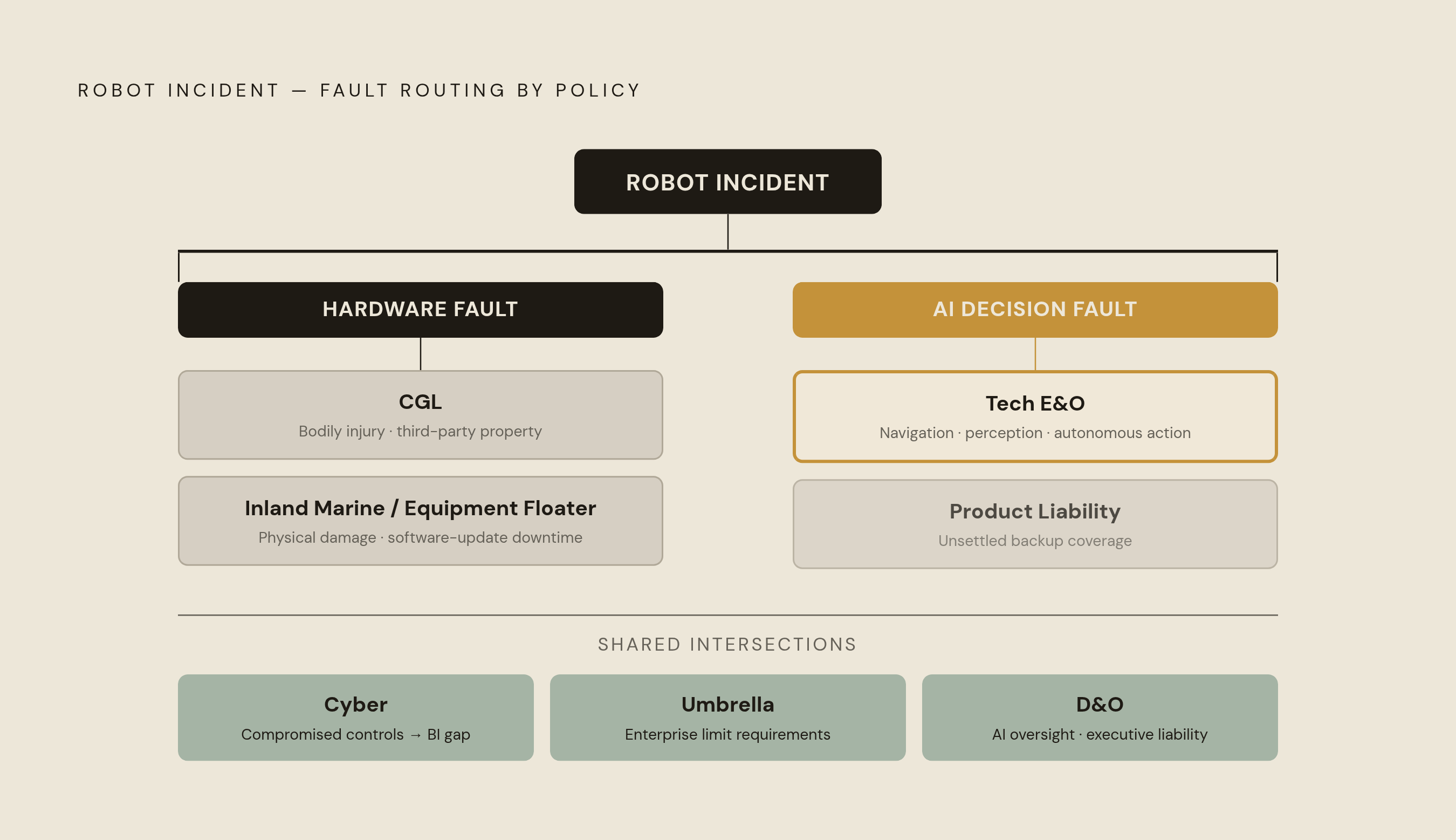
At the hardware layer, CGL covers injury and third-party property damage within its terms when they stem from a sensor malfunction, mechanical failure, or part-integration defect. Attribution remains important within that layer. An integration defect may place liability on the integrator rather than the original component maker, while inland marine or an equipment floater addresses the robot itself. Where expressly included, the equipment coverage also addresses production losses from a software update or sensor failure that takes the system offline without physical damage, which standard property coverage does not fill.
The AI decision layer addresses the customer’s financial or operational loss from a navigation decision, perception classification, or autonomous action. Tech E&O is the main source of coverage for that risk within its terms. Product liability may be a backup where the jurisdiction treats AI software as a product, but its legal status is still unsettled, so it cannot be relied on as the primary layer. The distinction affects placement before any claim arises. It identifies which losses have a defined policy route and which still depend on unresolved questions of legal classification.
At the intersections, cyber wording explicitly addresses the crossover from compromised robot controls to bodily injury or property damage. Umbrella coverage adds limits when enterprise or government contracts call for more than the underlying program provides. Neither addition works by label alone. Their value depends on how the terms connect to the loss scenarios already described in the submission. WTW identifies understanding overlaps and gaps, rather than assuming AI is covered, as a core risk-management task. An intentional gap is an exposure both parties understand and accept, while an accidental gap is one neither noticed because the submission never separated the fault modes.
What makes a specialist the right insurance broker for autonomous systems and robotics companies
A specialist robotics broker puts the distinction to work in the insurance market by checking policy language against the ways the system can fail. That work requires more than recording that a company makes or deploys robots. Generic forms do not perform the separation. A generalist submission that treats the operation as a single risk leaves the carrier’s exclusions to define its boundaries, rather than presenting a reasoned allocation of hardware and AI exposures. The specialist’s role is to contest unsuitable terms or route the risk to a carrier equipped to price it.
Carrier access is therefore part of the selection criterion. The architecture requires specialist markets that explicitly write autonomous and unmanned operations and have the claims history and appetite to evaluate their distinct failure modes. Standard market access does not necessarily reach them. For a robotics startup or warehouse operator, the useful comparison is whether a broker can translate governance records, override protocols, human oversight, training data sources, and indemnification scope into a layered submission. That is a more concrete test than whether the broker describes itself as familiar with technology companies.
The placement economics reinforce the importance of that capability. Broker commission is already built into the premium whether a generalist or specialist places the policy, so specialist placement does not itself add a charge beyond the premium. The buyer’s decision turns on whether the broker can secure terms matched to the operation, explain the exclusions, and identify what remains uninsured. That explanation should be available at submission and placement, before a robot incident forces several insurers to determine which version of the risk they actually agreed to cover.