How Underwriting Algorithms Detect Broker Specialization Before a Human Underwriter Opens an Autonomous Systems File
Specialty carriers score autonomy documentation before any underwriter reads it.

An insurance broker for autonomous systems and robotics companies must make the company’s technical risk legible to specialty carrier intake systems before a human underwriter reviews it. Strong submissions set out autonomy boundaries, safety evidence, model dependencies and coverage needs in fields that those systems can extract and score. A broker who specializes can both improve the submission and bring a placement history that algorithms use to rank it.
Why autonomous systems submissions are scored before a human underwriter sees them
Specialty carriers and managing general agents use automated intake pipelines to read, classify and route broker submissions before an underwriter opens the file. These systems can check appetite, request missing information and prepare a summary for review. The submission is already being evaluated at that stage. For an autonomous systems company, the first assessment therefore depends on what the initial package makes explicit.
That sequence changes the consequence of an incomplete submission. Missing technical information can lead to deprioritization or conservative pricing signals before a specialist underwriter has an opportunity to exercise judgment. A file may never reach that specialist at all. Automation reads applications faster and determines which applications receive attention and what structured account of the risk accompanies them.
What the triage algorithm is actually doing when it reads a submission
The intake pipeline begins by extracting information from broker emails, ACORD forms, loss runs and supplemental documents. Extraction models convert that material into structured fields, with confidence scores indicating how reliably the information has been interpreted. A technically detailed document is therefore useful only to the extent that its contents can be extracted into the variables the carrier uses.
The system then scores and ranks submissions that fit the carrier’s appetite. Ranking variables include premium size, broker hit-ratio history, renewal versus new business and submission completeness. Broker performance and portfolio context can also influence pricing signals, so two files describing similar operations need not enter the underwriting queue with the same priority.
Joyjit Roy and Samaresh Kumar Singh’s Agentic AI for Commercial Insurance Underwriting with Adversarial Self-Critique describes a human-in-the-loop framework in which a critic agent challenges the primary agent’s conclusions before human review. That safeguard still works from the information available to it. People may still catch extraction errors, but this safeguard shows why automated scrutiny needs structured inputs it can trust. A good risk poorly documented can remain difficult to distinguish from a risk whose controls are genuinely inadequate.
Why does a complete application still leave an autonomous robot company in a general liability bucket?
A generic commercial application can be complete on its own terms and incomplete against a specialty carrier’s appetite criteria. Standard forms do not supply the autonomy-specific documentation needed to classify a system’s operating boundaries and failure modes.
Operational design domain specifications and kill-switch architecture illustrate the gap. The first defines where and under what conditions the system is designed to operate, while the second explains how its autonomy can be interrupted. Neither is interchangeable with a general business description. The carrier needs those details to decide whether the exposure fits its appetite.
The mismatch also extends across coverage lines. Deployed autonomous systems can span CGL, technology E&O, cyber, inland marine and products liability, while a single-line application leaves their relationships unresolved. Those contexts must be set out in the submission, because a broad commercial classification leaves out how the risks arise.
How the ISO exclusion wave of 2026 changed what specialty algorithms are scanning for
ISO’s January 2026 filings, CG 40 47, CG 40 48 and CG 35 08, brought generative AI exclusions into the coverage analysis. Their scope requires precision. CG 35 08 01 26 deals with bodily injury and property damage that arise out of generative AI under the Products/Completed Operations Liability Coverage Part. It is not a blanket autonomous-systems or robotics exclusion, so the filings do not support treating every autonomous operation as excluded from standard coverage.
That distinction increases the need for specific intake data. A carrier assessing an autonomous system needs to understand whether and how generative AI enters its operations to determine coverage for a risk labelled “robotics. The submission must make the relevant dependencies visible. Where exclusions narrow standard protection, specialist intake criteria must show whether an operation fits the carrier’s affirmative appetite or has exposures that fall outside it.
Foundation-model dependencies introduce a separate portfolio concern. Multiple insureds using a shared upstream model can produce correlated losses if that model fails, making the identity of the model relevant beyond the individual account. An undocumented dependency leaves that concentration difficult to assess. The underwriting significance of the exclusion wave is therefore not merely new policy wording, but a stronger connection between technical architecture, appetite classification and coverage boundaries.
The specific submission signals that move an autonomous systems file to the top of the queue
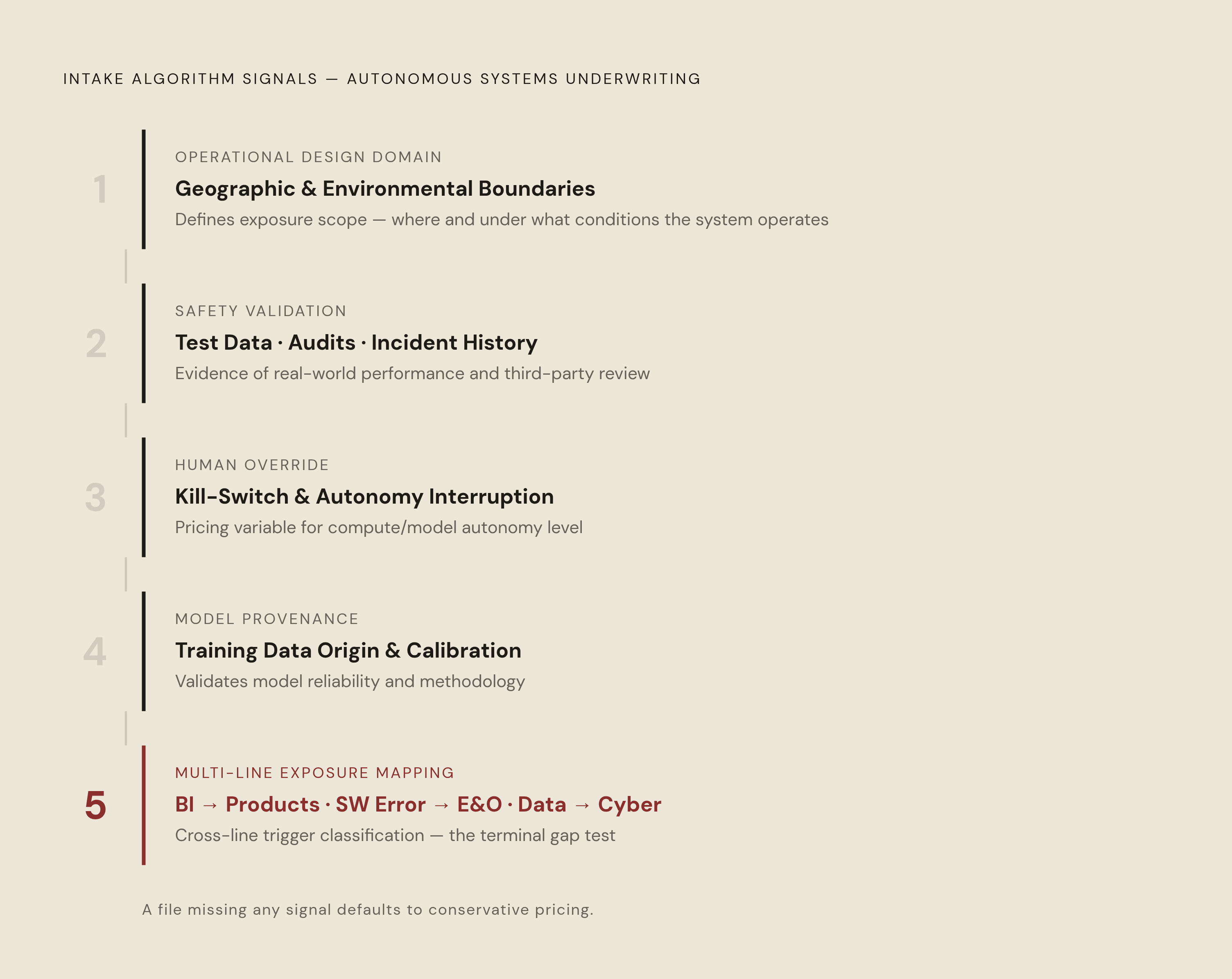
Operational design domain documentation gives the intake system geographic, environmental and operational boundaries it can compare with coverage territory and exclusion triggers. It establishes the intended operating envelope. A broad description such as autonomous hardware does not perform that function because it leaves the conditions of deployment unspecified.
Safety validation records add evidence about how the company manages risk within that envelope. Test data, third-party audits and incident history allow the carrier to assess the maturity of its controls. Missing records leave a substantive data gap. Kill-switch and human-override documentation then explains how the operator can interrupt operations, helping establish autonomy boundaries for carriers that use compute volume and model autonomy as pricing variables.
Training data provenance and model validation help show whether the company has worked out how the system can fail. The provenance record identifies where training data came from, while validation documentation explains how the model was evaluated. Calibration deserves particular attention within that evidence. Bertsimas and Orfanoudaki connect decision-threshold choices to tail risk, showing why a submission that documents calibration methodology gives an underwriter more useful information than an undifferentiated claim of model accuracy.
Multi-line exposure mapping connects those technical facts to the intended insurance response. It identifies bodily injury from a collision as a products liability exposure, software error as a technology E&O exposure and data exfiltration as a cyber exposure, subject to the policy wording. The mapping makes the proposed allocation of failure modes to coverage lines explicit for the intake system.
Audit logging and trust stack documentation give carriers more information to use in specialty autonomous AI underwriting. Their presence allows the pricing process to work from documented controls rather than conservative assumptions about missing information. Together with the operating boundaries and validation evidence, they give extraction models specific fields to populate and underwriters a coherent account to evaluate.
Why broker specialization is legible to the algorithm independently of submission content
The intake system can evaluate the sender as well as the file. Broker performance profiles include hit ratio, submission completeness history and account quality, so past placements can affect how a new submission ranks. A broker whose accounts have consistently been complete and in appetite brings evidence that is separate from the documents attached to the current application.
A generalist can improve a particular file by including the required technical fields, but that improvement does not reset the broker’s historical profile. The analytical distinction is therefore between a broker who knows what belongs in this submission and one whose previous submissions have also demonstrated that knowledge to the carrier.
In the framework described by Roy and Singh, the critic agent evaluates conclusions built from the extracted information, so clearer inputs reduce the grounds for data-quality concerns. This does not make specialist status a guarantee of priority. Premium size, appetite fit, portfolio context and the quality of each file still matter, but broker history helps explain why equally polished applications can be treated differently at intake.
What enterprise and government contracts now require from an autonomous systems insured — and how triage intersects with it
The coverage mapping needed for carrier intake also helps a company meet the terms of its customer contracts. Enterprise buyers increasingly distinguish autonomous system failures from general intellectual property or data indemnities, making the wording of the insurance response consequential. A certificate alone cannot establish that response. If the policy does not cover the autonomous operations addressed by the indemnity, a generic description of insurance will not resolve the mismatch.
Armilla’s 2026 analysis of enterprise MSAs describes requirements for CGL, technology E&O, cyber liability and professional liability, with AI-related limits that often reach tens of millions of dollars. Requirements can also include naming the deploying organization as additional insured, providing certificates before deployment and supplying renewal certificates on material policy change. If the submission fails to identify the relevant parties and failure modes, underwriting approval can still produce a policy that does not satisfy the customer’s contract.
Government contracts pose a similar challenge because they have tailored warranty and indemnification provisions for AI-generated errors, bias and unintended behavior. A generic professional liability policy is unlikely to cover every such trigger, so it needs to be checked against them. Multi-party deployments make the coverage design more complex. Marsh and Apollo’s ibott division announced an autonomous vehicle insurance facility on March 12, 2026, for Uber’s global AV platform, covering developers, fleet operators, vehicle manufacturers/owners and OEMs under a single master policy.
That bespoke facility illustrates the direction of enterprise-scale placement. Its relevance is the explicit treatment of several parties within one coverage structure. For a Series A or Series B autonomous systems company, a placement can clear underwriting yet fail the customer’s legal review when policy wording is compared with the indemnification clause.
What clearing algorithmic triage actually requires from an autonomous systems company
The company provides accurate technical documentation in plain language, including its operational design domain, safety validation records, model architecture and audit logging. The broker translates that evidence into underwriting terms. That work includes identifying carrier appetite, understanding the fields relevant to intake and structuring the submission so extraction produces reliable data.
Buying before autonomy scales allows simpler systems to establish an insurability history that can make later expansions cheaper. Broker credibility likewise accumulates account by account. Selecting a specialist with a relevant placement record therefore gives the company access to an existing history, rather than requiring the current file to supply all the evidence of submission quality on its own.
Broker commissions are built into the premium whether a specialist or a generalist places the policy. Broker selection therefore turns on coverage and triage outcomes. Before binding, a licensed broker must check the policy wording against the company’s operational profile, because a score for completeness and appetite fit cannot show whether exclusions leave the intended protection in place.